
Should dogs wear collars or harnesses? It’s an important question for dogs of all ages, but particularly for puppies, whose developing bones, muscles and joints need extra care.
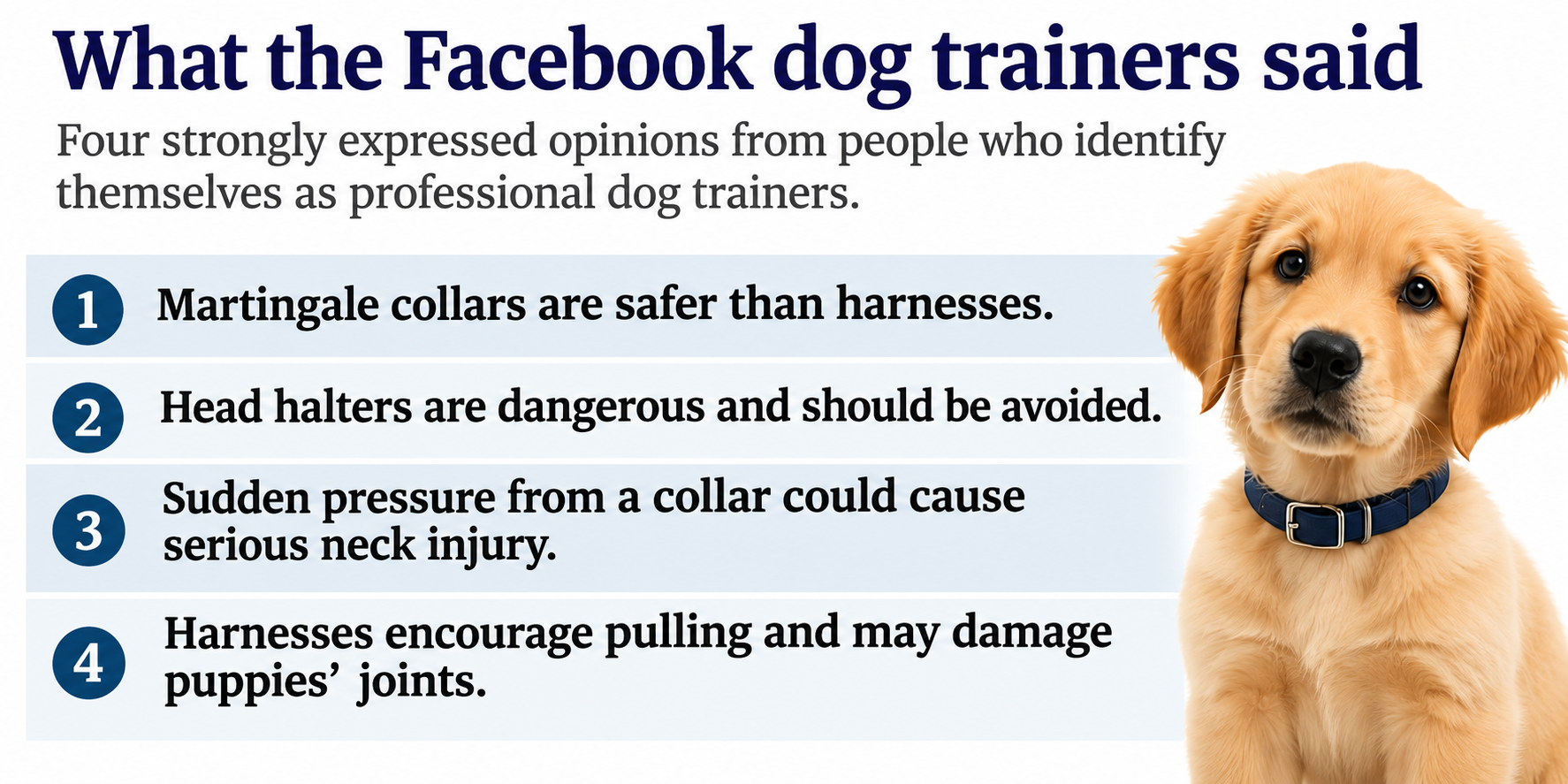
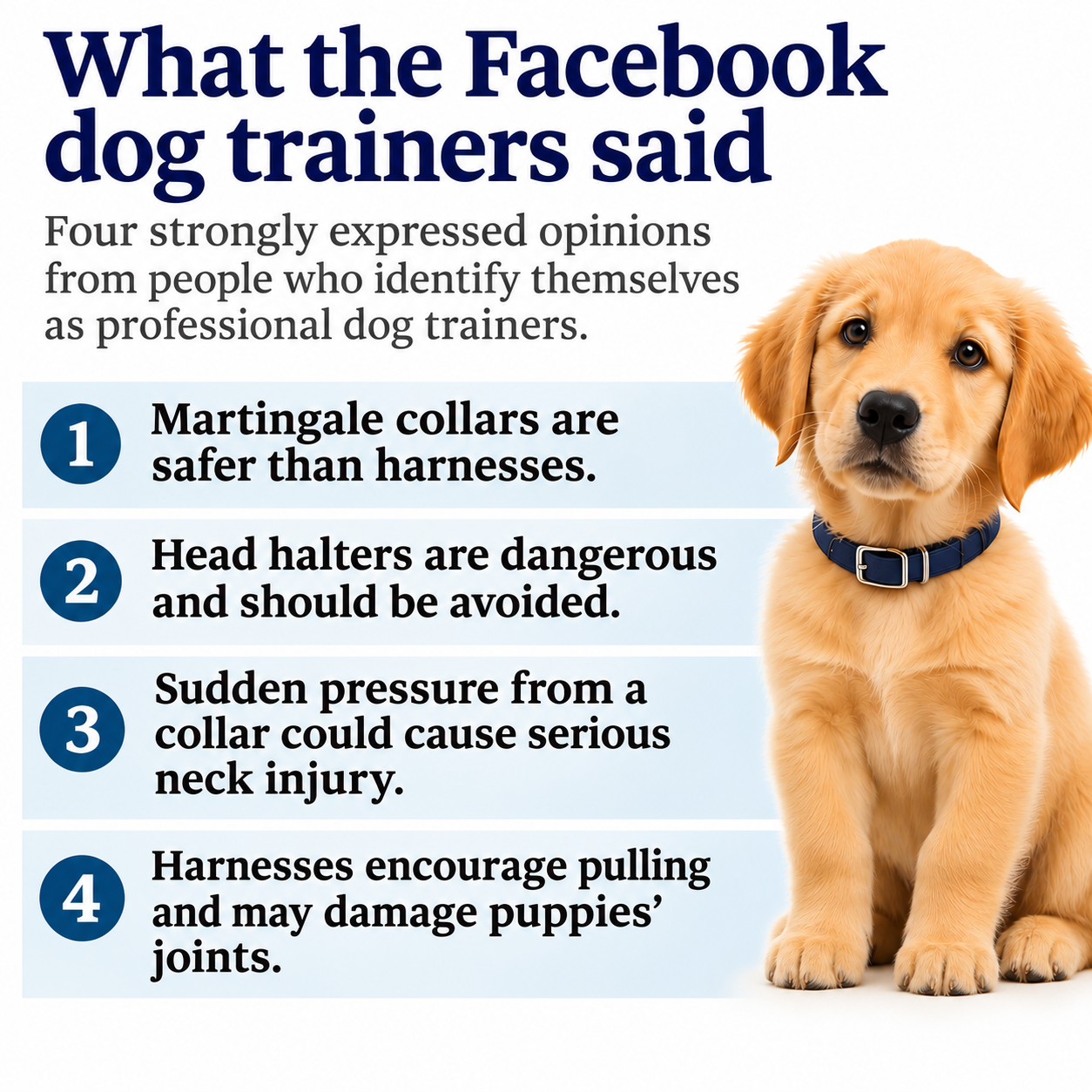
A recent Facebook dog-training discussion highlighted the conflicting advice owners encounter whenever this subject comes up. Some warned of serious neck injuries. Others insisted martingale collars were better than harnesses. Head halters were condemned as dangerous, while harnesses were accused of encouraging pulling and damaging growing puppies.
What struck CLEAR Dog Training owner Caroline Strainig was that some of the strongest, most contradictory opinions came from people identifying themselves as professional dog trainers. Caroline thought the subject was worth exploring. What does the research actually say, and how should owners choose the right walking equipment for their dogs?
What does the science say?
A 2020 study published in Veterinary Record measured the pressure different collars exerted on a simulated dog’s neck. It found that pulling could generate considerable pressure, raising concerns about dogs repeatedly pulling or being jerked against a collar. Young puppies warrant particular care because their bodies are still developing, but dogs of any age can suffer neck injuries from excessive pressure, especially when they pull hard, lunge or experience sudden jerks.
That doesn’t mean ordinary flat collars are automatically dangerous. It does suggest that allowing a dog to pull continuously against its neck isn’t sensible.
Harnesses have attracted scrutiny too. Research suggests some designs can affect shoulder and front-leg movement, but that doesn’t necessarily mean permanent damage. There’s insufficient evidence to support sweeping claims that harnesses damage growing puppies.
A 2025 review of research into walking equipment favoured non-tightening front-clip harnesses for dogs that pull, while recognising that flat collars are suitable for dogs that walk without pulling. It also raised concerns about discomfort associated with tightening equipment. RSPCA Australia generally favours comfortable, correctly fitted harnesses, particularly where neck pressure is a concern.
The takeaway? Fit, design, handling and the individual dog all matter.
Why CLEAR generally favours harnesses
For dogs learning to walk on lead, Caroline generally recommends a well-fitted Y-front harness that allows comfortable shoulder movement. A front attachment point can be particularly useful for gently redirecting an enthusiastic dog. But not all harnesses deserve a gold star. Caroline regularly encounters dogs wearing harnesses that are too big, rubbing under their legs, restricting movement or so loose they could wriggle out.
And what about the argument that harnesses encourage pulling? A dog can certainly discover that leaning into a back-attachment harness is an excellent way to tow its owner towards an interesting smell. But that’s not because the harness has magically taught the dog to pull. It’s because pulling works! A harness can make training more comfortable, but it won’t teach loose-lead walking by itself.
In defence of the humble flat collar
Here’s something often overlooked in the equipment debate: convenience matters. Caroline encourages owners to practise loose-lead walking in frequent, short sessions, starting somewhere easy, such as the living room, hallway or backyard.
Being able to clip a lead onto a dog’s collar and practise a few steps takes seconds. If every session involves finding and fitting a harness, there’s a good chance you’ll practise less often. This applies just as much to a newly adopted adult dog or an adolescent that hasn’t yet mastered loose-lead walking as it does to a young puppy. Age doesn’t necessarily mean experience!
For gentle practice where the dog isn’t pulling or lunging, a properly fitted flat collar is sensible. For walks in the exciting outside world, where the dog may be less predictable, a harness often makes better sense. There’s nothing wrong with using both.
What about martingales and Haltis?
A martingale, sometimes called a half-check collar, typically has an adjustable fabric collar with a short chain section, although some versions use fabric throughout. When the dog pulls, the collar tightens, but unlike a traditional full check chain, a correctly adjusted martingale can only tighten to a predetermined point.
This makes martingales particularly useful for dogs such as greyhounds, whose narrow heads allow them to slip out of ordinary collars. However, they still exert pressure on the neck and must be fitted correctly.
Head halters, including Haltis, can be valuable training aids, but Caroline believes they’re frequently misused. Too often, an owner fits a Halti, clips on a lead and heads off. The untrained dog pulls or lunges, repeatedly experiencing pressure on its nose and head. Instead of a gentle training aid, the Halti becomes the primary means of control.
Caroline would never introduce a Halti to a young puppy. She prefers to establish basic loose-lead walking skills first, usually with a front-clip harness. The manufacturer recommends Halti training headcollars for dogs aged nine months and older.
When Caroline does recommend one, she teaches clients to use a double-ended lead. One end attaches to the collar or harness for primary control. The other attaches to the Halti for exceptionally gentle guidance when needed. Any safety attachment must also be fitted according to the manufacturer’s instructions. The dog must first be introduced to the head halter gradually and positively, and the owner taught how to use it correctly.
Caroline’s golden rule? Imagine your dog’s nose is made of glass. That means the lightest possible guidance, never jerking or dragging the dog’s head around.
A caution about Facebook advice
The Facebook debate highlighted a broader problem. Confident opinions, even from people identifying themselves as professional trainers, aren’t necessarily supported by evidence. When someone makes alarming claims about injuries, it’s worth checking reputable veterinary sources and published research before accepting their comments as gospel.
Facebook can be a great place to exchange experiences, but it’s not necessarily the best place to find reliable dog-training advice.
So, who’s right?
Dog owners don’t need to enlist in either the collar camp or the harness camp. The best choice depends on the dog, the handler and the circumstances. Whatever equipment you choose, make sure it fits properly and use it sensibly. Above all, good loose-lead walking is a skill that needs to be taught, regardless of the dog’s age.
Start somewhere quiet, reward a few lovely steps on a loose lead and gradually introduce distractions. Give your dog opportunities to sniff and explore, too. And please don’t expect a dog that’s barely learned to walk on a lead to perform as though it’s competing in the heelwork competition at the Australian National Championships!
The goal isn’t a perfect competition heel. It’s a happy, comfortable dog that can enjoy a walk without towing its owner from one exciting smell to the next. And surely that’s something even the Facebook dog trainers could agree on!
Further reading
For more on walking equipment, see CLEAR’s Choosing the right walking equipment. For practical training advice, see Seven steps to better loose-lead walking.