Walk into any pet shop and you’ll be confronted by an entire wall of collars, harnesses, leads and gadgets, all promising to make walking your dog easier. It’s no wonder owners are confused.
One of the first things CLEAR Dog Training owner Caroline Strainig asks new clients to do before a home visit is lay out every piece of walking equipment they own. It’s amazing what appears on the lounge room floor. There might be three different leads, a couple of collars, two harnesses and something bought online after a particularly bad walk.
Most of it has been purchased for the same reason: the hope that the next piece of equipment will make walking easier. Sometimes it does help, but no collar, harness or headcollar teaches a dog to walk politely. The equipment is there to make the job easier while the training catches up.
Flat collars are handy for training at home
A properly fitted flat collar is perfectly sensible for gentle, early lead training in a quiet environment. At home, it’s wonderfully convenient. You can simply clip on a lead, practise a two-minute loop around the house or garden, then finish. No fuss, and plenty of opportunities for little training sessions throughout the day.
This applies just as much to a newly adopted adult dog as it does to a young puppy. Used sensibly, without pulling, lunging or jerking, a flat collar can be a useful training tool. Once you’re venturing into more distracting environments, where the dog is less predictable, a harness generally makes better sense.
Start with a good harness
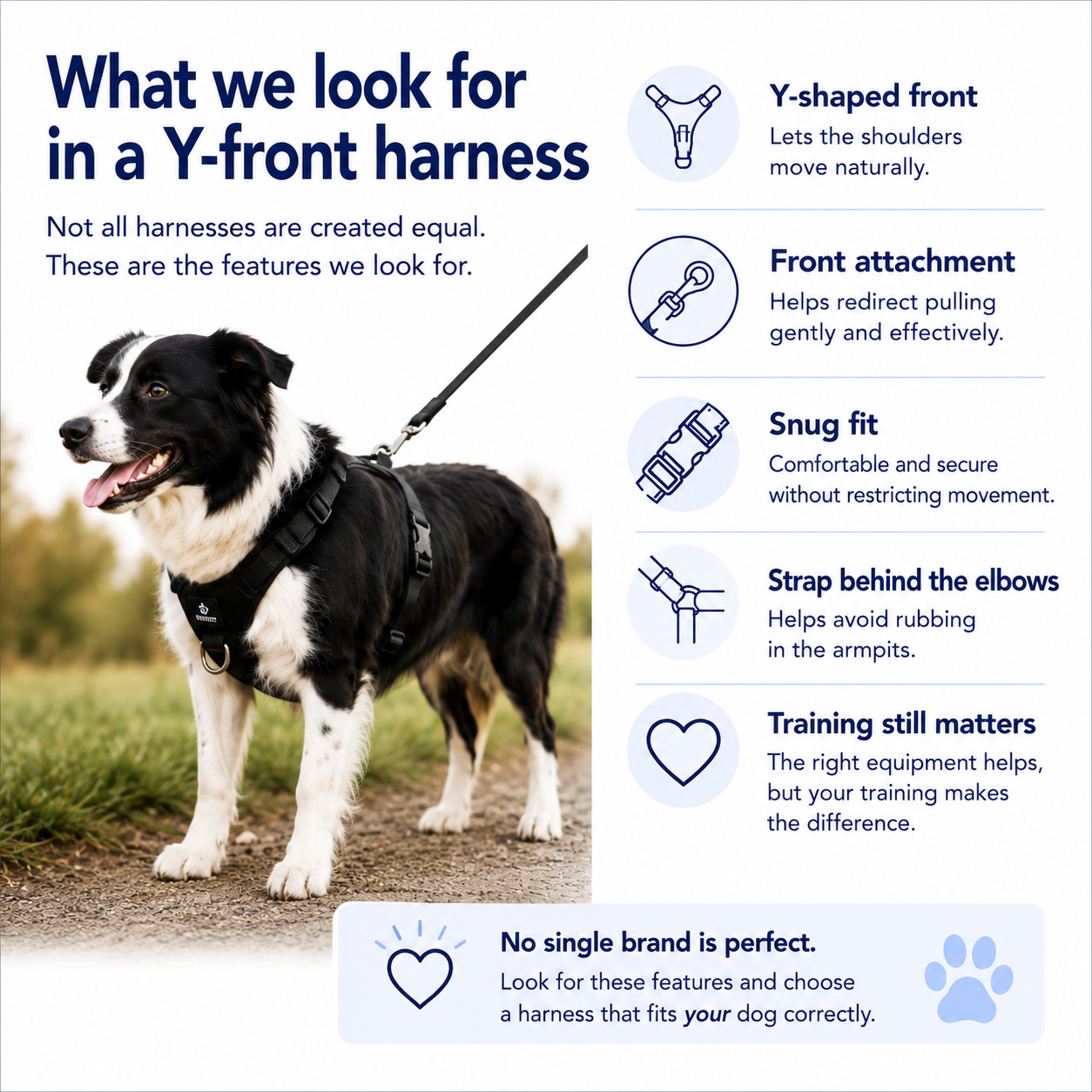
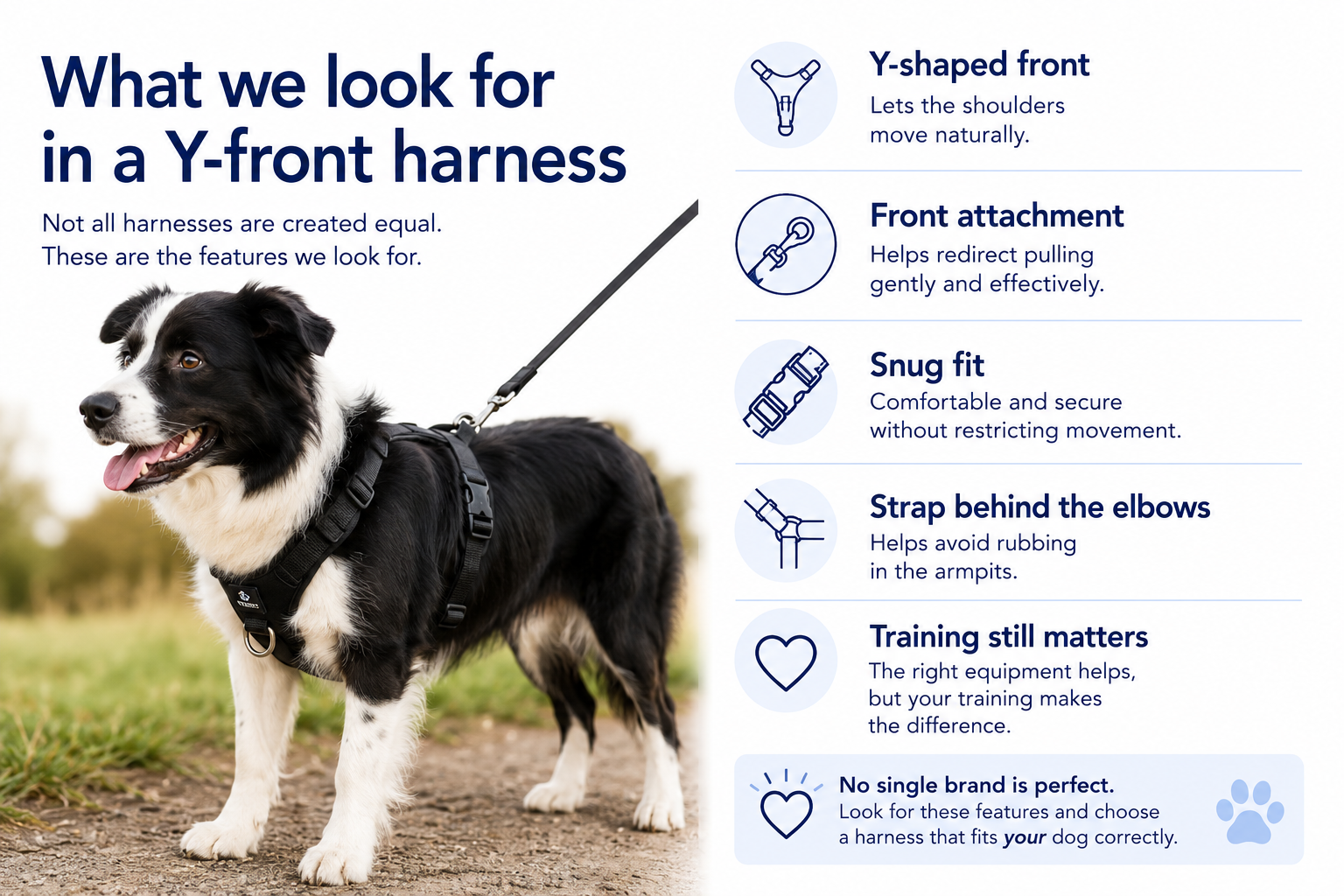
For most pet dogs, CLEAR recommends a well-fitted Y-front harness with both front and back attachment points, used with a double-ended lead. A good design generally allows comfortable shoulder movement, while correct fitting helps prevent the harness sliding around, twisting or rubbing.
Before you even think about attaching a lead, make sure your dog is comfortable wearing the harness. This is a separate training exercise, particularly important for puppies and dogs unfamiliar with wearing equipment. Let the dog investigate it, reward it for putting its head through or allowing it to be fitted, and gradually build up to wearing it comfortably around the house.
Once your dog is relaxed in the harness, you can introduce walking. A double-ended lead gives you flexibility: both ends can attach to the back when the dog is walking calmly, or one can move to the front when you need more control.
The front attachment is useful for dogs that surge ahead or pull towards distractions. You might stop and wait for the lead to loosen, or turn and quietly walk the other way. Reward your dog when it comes back with you, walks near you or checks in. The harness helps, but your dog still needs to learn what you want.
Try before you buy
If you already own a harness without a front attachment, it may be possible to improvise one to see whether it helps before buying another harness. However, the connection must be absolutely secure. Never rely on an improvised attachment until you’re certain it cannot slip or fail, and always maintain a secure connection to the harness’s existing attachment point.
A temporary attachment should never be the primary restraint for a powerful or reactive dog. The harness itself must also fit reasonably well, or you won’t get a fair idea of how useful a properly fitted front-clip harness can be.
For dogs that slip their collars
Some dogs are surprisingly good at reversing out of ordinary collars. For those dogs, a properly fitted martingale can provide extra security.
Sometimes called a half-check collar, it typically has an adjustable fabric section and a short chain section, although some versions use fabric throughout. Unlike a traditional full check chain, it can only tighten to the point you have set.
Martingales are particularly useful for dogs such as greyhounds, whose narrow heads allow them to slip out of ordinary collars. However, they still exert pressure on the neck and need to be fitted and handled correctly.
When a Halti is useful
A Halti or other dog headcollar can help with a very strong puller, a reactive dog or where the handler needs additional control. But CLEAR generally recommends trying a front-clip harness first. If that provides enough control to train comfortably, a Halti may be unnecessary.
Caroline would never introduce a Halti to a young puppy, preferring to establish basic loose-lead walking skills first. The manufacturer recommends Halti training headcollars for dogs aged nine months and older.
If you do move to a Halti, introduce it gradually and positively. Start at home, put it on briefly, reward your dog and remove it. Gradually build up to wearing it comfortably around the house before attempting a walk.
Some dogs accept a Halti immediately. Others behave as though you’ve attached an octopus to their face. They paw at it, rub their head along the carpet or throw themselves into a full crocodile roll!
Keep these sessions short and positive. If your dog becomes distressed, make the exercise easier rather than forcing it to tolerate the headcollar.
Once comfortable, your dog can wear the Halti on short walks while the lead remains attached to its collar or harness. Later, use a double-ended lead, with one end attached to the collar or harness for primary control and the other to the Halti for exceptionally gentle guidance. Fit any safety attachment according to the manufacturer’s instructions.
This is particularly important with anxious or reactive dogs, where unnecessary pressure on the headcollar may add to an already stressful situation.
Caroline has a simple rule: Imagine your dog’s nose is made of glass. Any guidance through the Halti should be extremely gentle, never a jerk or sustained pressure.
Leads matter too
People often spend a lot of time choosing a harness and very little time thinking about the lead. A good lead should feel comfortable in your hand, have a reliable clip and be strong enough to cope with the unexpected.
Caroline learnt that lesson the hard way when her Border Collie Hope was attacked after another dog snapped the pencil-thin lead it was attached to. It was a sharp reminder that flimsy leads and tiny clips can become a genuine safety issue.
A washable silicone treat pouch is worth having too. If you’re trying to reward good choices on a walk, you need to be able to get to the food quickly rather than digging around in a pocket.
And if your dog can still take you by surprise, wear sensible shoes. Thongs and enthusiastic dogs are not always a great combination!
Keep it as simple as you can
There is no single walking setup that suits every dog. For many dogs, a good Y-front harness, a strong double-ended lead and a pocketful of treats will do the job nicely. Dogs that walk calmly may be perfectly comfortable on a flat collar, while others may benefit from the added security of a martingale or the carefully introduced guidance of a Halti.
What matters is that the equipment fits properly, keeps everyone safe and gives you enough control to get on with the training.
For tips on teaching your puppy or adult dog to walk nicely on lead, see Seven steps to better loose-lead walking.
The aim isn’t to keep adding more gear. It’s to reach the point where walking together becomes easier because both ends of the lead know what they’re doing.