
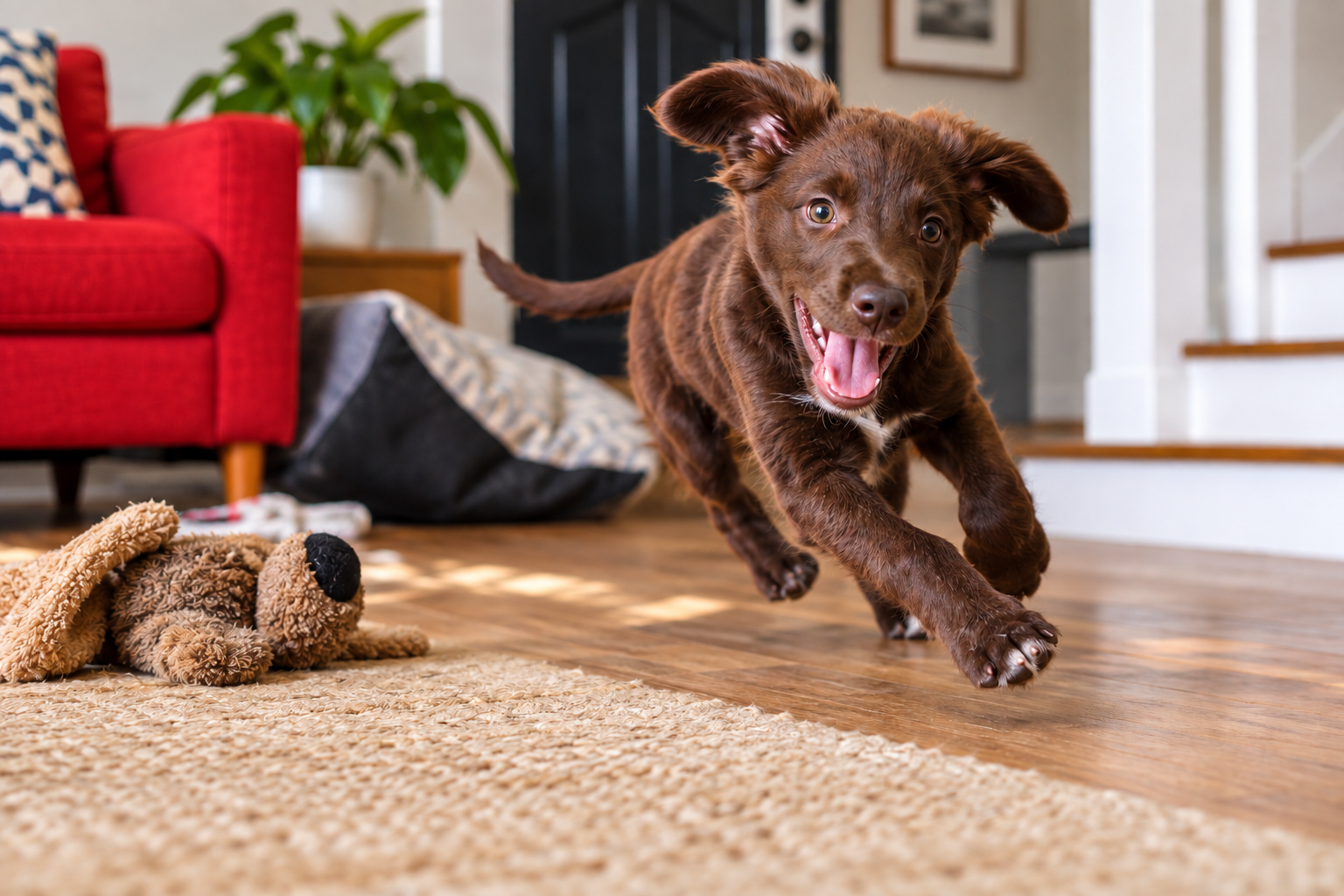
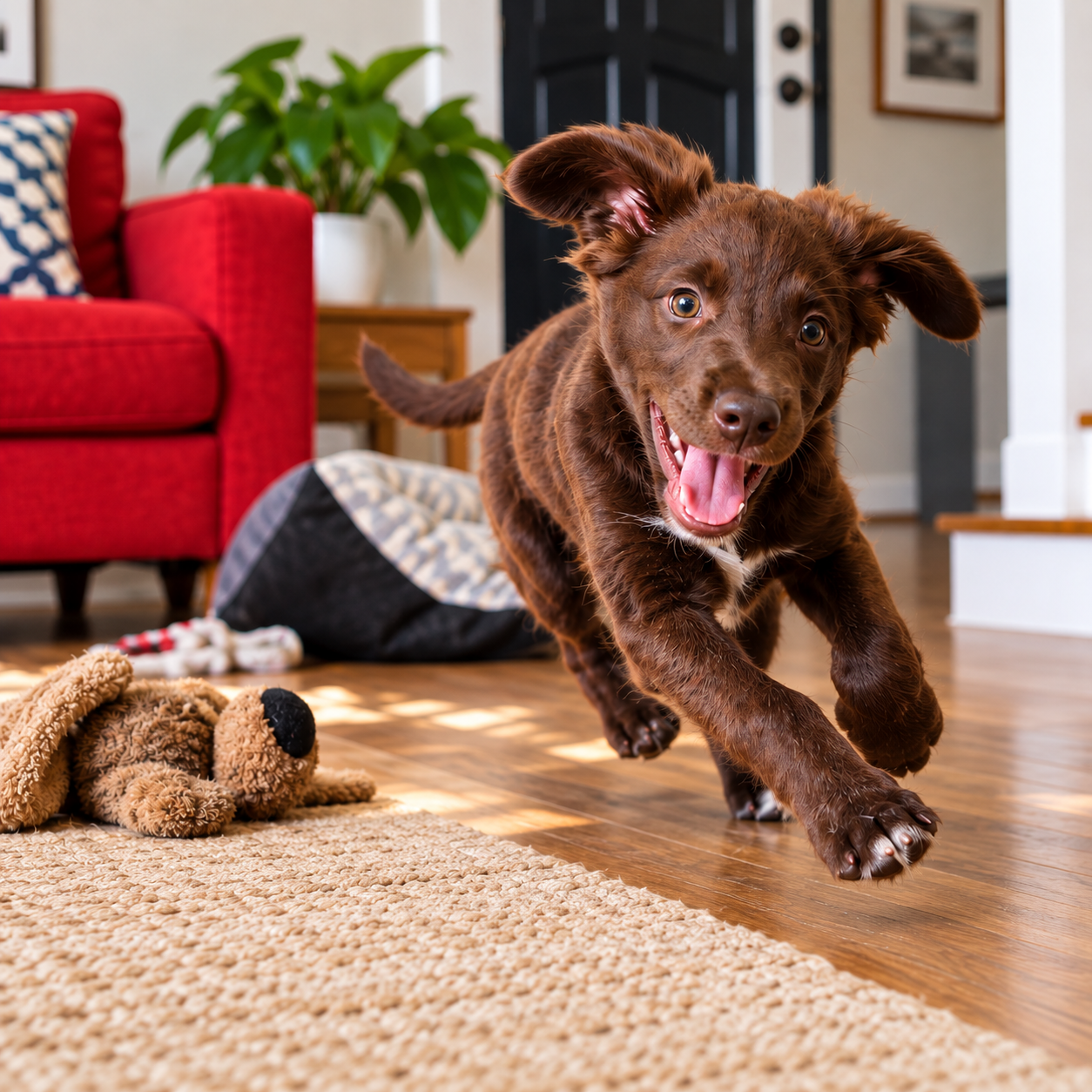
It’s 4 pm. Your puppy has been delightful for most of the day, but you know what’s coming. Batten down the hatches. Within the next few hours, that sweet little dog may be replaced by a furry missile with teeth, no brakes and an apparently irresistible urge to launch at you, your clothes and anything else within range.
Welcome to the puppy witching hour.
Most puppies seem to have several operating modes. At one end is what we call cocktail-by-the-pool mode: relaxed, chilled and apparently incapable of putting a paw wrong. At the other is ballistic missile mode. Somewhere between the two is where we’d ideally like our puppies to spend much of their time — bright, energetic and interested in life, but still capable of listening and thinking.
If your puppy regularly goes slightly bonkers late in the day, you’re certainly not alone. The good news is that there are ways to make the witching hour considerably more survivable.
When excitement tips over
Zoomies themselves aren’t necessarily a problem. Puppies need to run, play, explore and occasionally be ridiculous. What matters is recognising when ordinary exuberance is tipping into such high arousal that your puppy is struggling to make sensible choices — and you’re beginning to wonder who you can give them to.
Sometimes there isn’t one obvious cause. Your puppy may have had a walk, visitors, an exciting training session, children playing with them and a particularly energetic game in the backyard. Each might have been perfectly manageable on its own, but together they can push an already excited puppy over the edge.
This is often called trigger stacking. Think of the proverbial straw that breaks the camel’s back. It isn’t necessarily the final straw that caused the problem; it’s the accumulation of everything that came before it. Looking back over your puppy’s whole day can sometimes explain why tonight’s witching hour is particularly spectacular.
Sometimes the ballistic missile needs a nap
An overtired puppy can be remarkably like an overtired toddler. The more tired they become, the less capable they seem of switching off, and sometimes the result looks remarkably like a tantrum. Making sure your puppy gets plenty of genuine rest during the day can make a real difference.
This can be particularly important in households with children, where an appealing new puppy may have an almost continuous stream of people wanting to play with them, cuddle them or pick them up. Puppies aren’t stuffed toys. Give yours somewhere quiet and comfortable to sleep, and encourage everyone to leave them alone when they’re resting unless there’s a genuine reason to disturb them.
Don’t join the puppy wrestling team
It can feel quite natural to get down on the floor and play with your puppy when they’re full of beans — and at calmer times that can be great fun for everyone. The difficulty comes when a puppy is already highly aroused. Once you’re down at their level, you can suddenly become much more like another puppy, which may make the play even rougher. Unfortunately, you don’t have fur protecting your face and arms.
If your puppy tends to launch, scratch or grab when excited, we prefer toys that put a little distance between human skin and puppy teeth. A toy on a longer rope that you can drag along the ground can be useful.
Choose the game according to the puppy in front of you, too. If your puppy really gets into tug, loves it and thinks it’s the best game in town, it can become very arousing. There’s nothing wrong with that when you want an exciting game, but if your puppy is already heading towards ballistic missile mode, tug may simply send them up another gear. At those times, look for activities that bring the temperature down rather than turning it up.
Teach calm before you desperately need it
One exercise we use at CLEAR is teaching puppies to settle quietly on lead at their owner’s feet. It’s much easier to teach this when your puppy is reasonably receptive, rather than waiting until the witching hour is in full flight.
Sit down, put your foot on the lead and disengage. Read a book or watch television. Don’t stare at your puppy or continually talk to them. Allow enough lead for your puppy to sit or lie comfortably at your feet, but not enough to wander around looking for something more entertaining to do.
When your dog settles, either lying down or sitting quietly in front of you, gently place a treat on the ground between their front legs. If you use a marker word in your training — most commonly “yes” — quietly use it as you place the treat. Otherwise, simply give some calm praise. We’re not rewarding the puppy for staring lovingly into our eyes; we’re rewarding chilling out. Keep the whole exercise wonderfully boring and Zen-like.
As your puppy becomes familiar with the exercise, you may find they settle much more quickly as soon as your foot goes on the lead. Once they’re genuinely comfortable with that restriction, the lead can become another useful management tool. If necessary, it can be looped around a solid object and brought back to you, keeping an especially rambunctious puppy just out of reach. We wouldn’t start there, though. Teach the simple version first, and don’t tie an inexperienced puppy up and leave them.
Don’t become the entertainment provider
If you know your puppy usually erupts around 5 pm, try to be proactive rather than waiting for the wheels to fall off. That might mean having a Kong, chew, quiet activity or some downtime organised before your puppy starts swinging from your trouser leg.
Otherwise, it’s surprisingly easy to create a behaviour chain. A behaviour chain is simply a series of actions that become linked because one action reliably produces the next. Puppy goes ballistic → puppy bites you → you produce the favourite toy → fabulous entertainment begins.
You may think you’ve successfully redirected the biting. Your puppy may have learned something quite different: bite the human and good things appear. They’re not plotting your downfall; dogs are simply very good at noticing what works and repeating it. Before long, your puppy can become remarkably efficient at training you.
That’s one reason we’re a little cautious about the blanket advice to redirect every unwanted behaviour onto a toy. Redirection can certainly be useful, but think about the sequence you may be creating. If your puppy has already erupted and you still need to give them a Kong, chew or toy, wait for a little pocket of calm before producing it. We’d rather have the good stuff follow calm behaviour than inadvertently pay for the preceding performance.
Teach it easy, then try it harder
There’s another reason to do your useful training before the witching hour arrives. Recall games, relationship games and other familiar exercises are much easier to teach when your puppy is attentive and capable of learning. Once those behaviours are well understood, you can start seeing whether they transfer when your puppy is more excited.
Sometimes they will. A puppy racing around in zoomie mode may still be able to respond to a familiar game, reconnect with you and come back down a notch. That’s a useful skill, and one worth building gradually rather than expecting it to work for the first time when your puppy is already bouncing off the walls.
Other times, however, you’ve missed the window. Your puppy’s brain has temporarily left the building and another training exercise is unlikely to improve matters. That’s when management wins. Separate yourself if you need to. Give your puppy some safe space, a quiet activity or simply the opportunity to decompress. You don’t have to turn every ballistic episode into a training opportunity.
The aim isn’t to produce a puppy who never gets excited. Puppies should play, race around, explore and enjoy being puppies. We’re simply helping them discover that life has more than two settings.
And if tonight is particularly spectacular? Take heart. Tomorrow morning, there’s every chance your ballistic missile will be back in cocktail-by-the-pool mode.
Need hands-on help?
Sometimes a little one-on-one help makes all the difference. CLEAR offers practical, personalised dog training across Wynnum–Manly and Brisbane Bayside, tailored to you and your dog.