Dog parks can be brilliant fun — until they’re not. Knowing what to watch for can make the difference between a great outing and a stressful one.
A recent conversation at Elanora Park, Wynnum, got CLEAR Dog Training owner Caroline Strainig thinking about the subject again. A past client stopped to ask about her dog, which usually played well with others but could occasionally become a little too rough. There was also one particular dog it had some history with after previous play had become intense. Should she interrupt and move her dog away? Or, if things settled quickly, could the dogs have another go?
There isn’t always a simple yes-or-no answer. Much depends on what the dogs are actually doing, whether both still seem happy to be involved and what happens after a short break.
Caroline is fairly cautious about dog parks. She trains her own dogs near Elanora Park in Wynnum and regularly sees interactions that make her wince. A few weeks ago she ventured into a quiet area with her young, friendly male. Within about five minutes, another dog came over and started bullying him.
That doesn’t mean dog parks are bad. A confident, sociable dog that genuinely enjoys meeting others can have a wonderful time. But for an anxious, reactive or easily overwhelmed dog, a busy off-leash park can feel very different.
Imagine being taken to a party where you know nobody, you stand out from everyone else and you can’t even speak the same language. Then strangers keep walking straight into your personal space. Some dogs cope beautifully with that. Some don’t.
Rough doesn’t always mean wrong
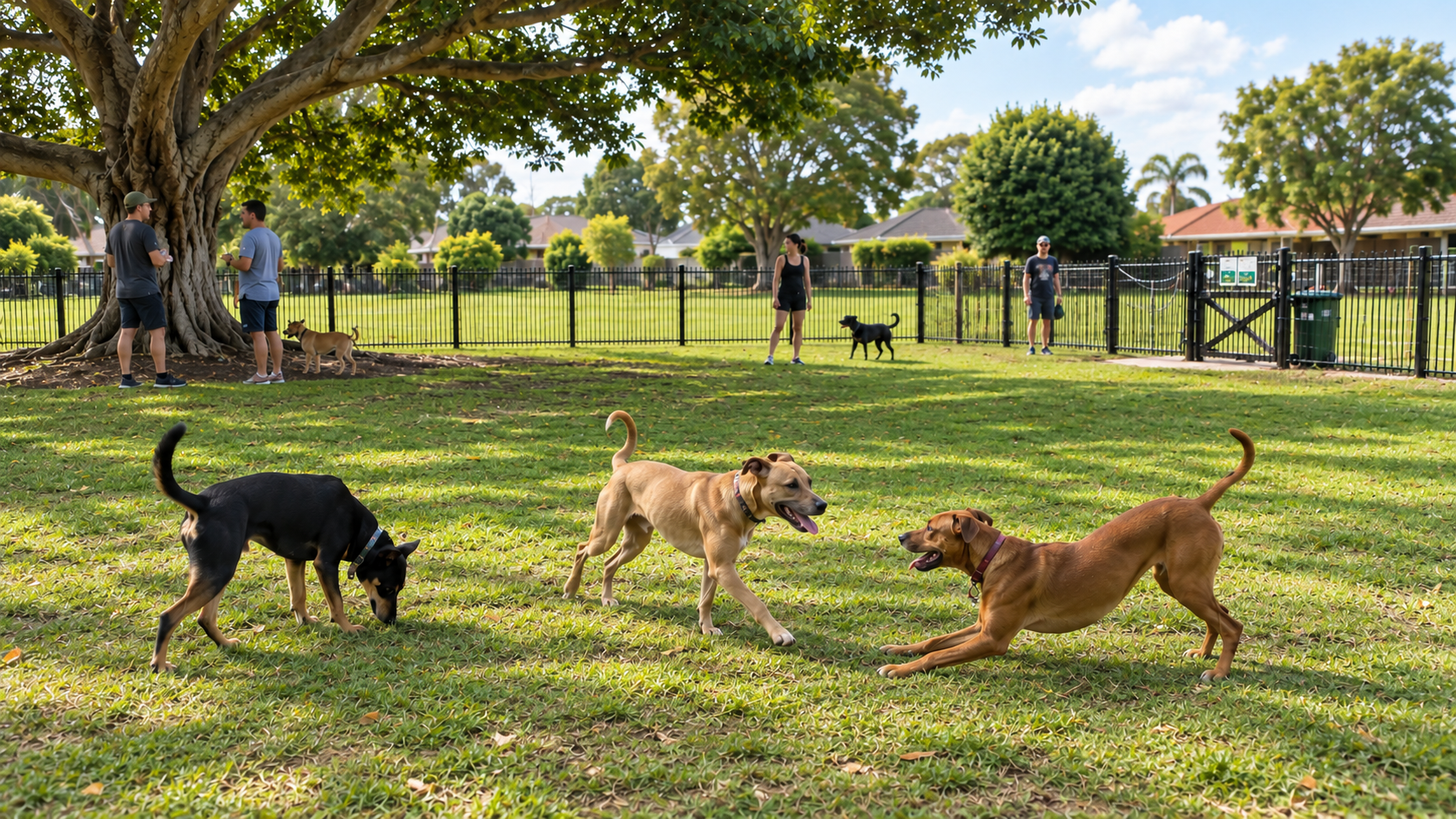
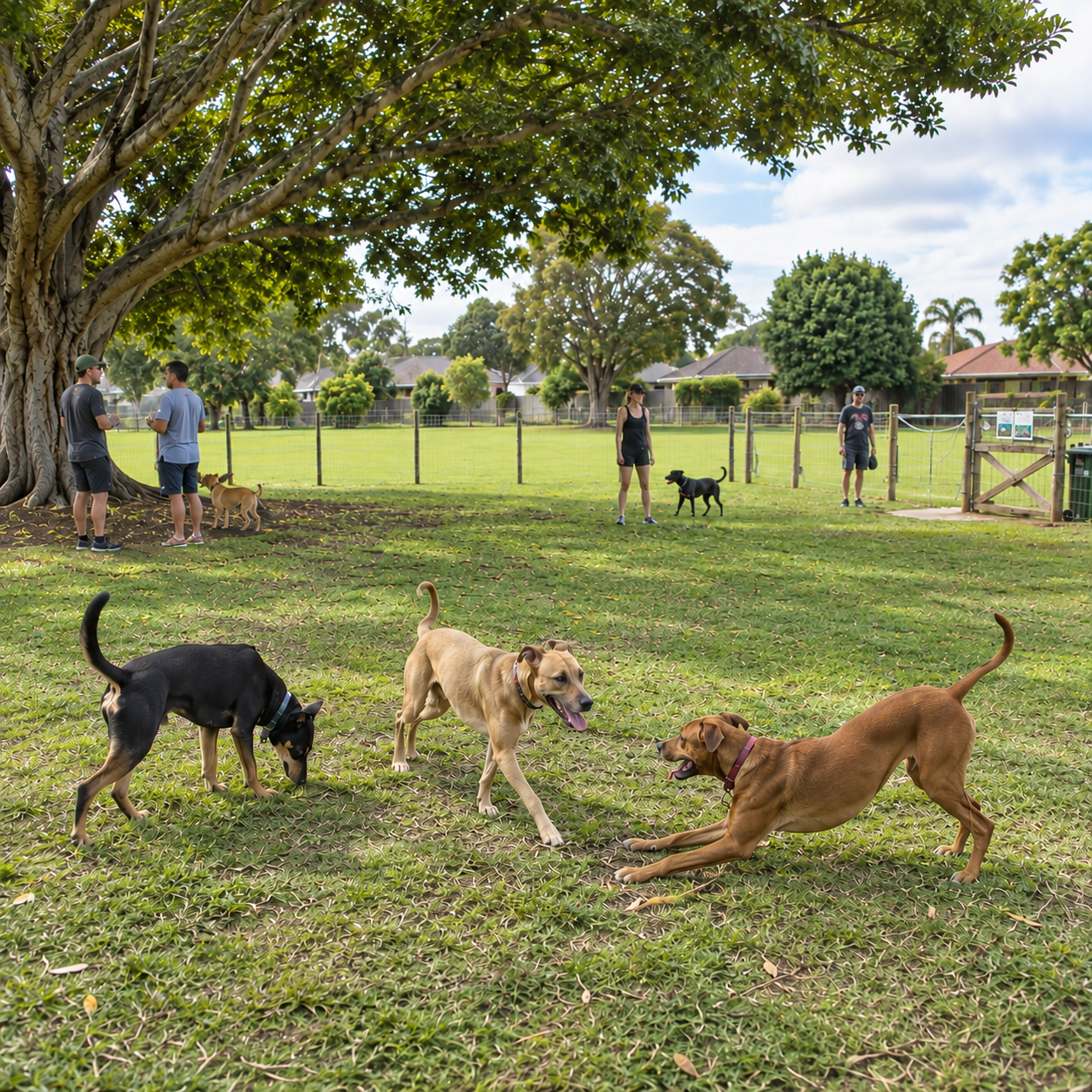
Dog play can look surprisingly dramatic. There may be chasing, growling, wrestling, shoulder-barging and plenty of rolling around, yet both dogs can still be having a fabulous time. The useful question is not simply, “Is this rough?” but, “Are both dogs still choosing the game?”
In good play there is often a bit of give and take. One dog chases and then gets chased. Wrestling positions change. There may be little pauses before somebody starts things up again. The dogs generally look loose rather than stiff and, importantly, both keep coming back for more.
Chasing is worth watching a little more closely because a dog running away is not necessarily joining in. Some dogs race off, loop around and come straight back to invite another chase. Others are trying very hard to get away. A tucked tail, frantic running, hiding behind an owner or repeatedly trying to leave the interaction can paint a different picture.
A dog that feels trapped may eventually turn and snap simply because its earlier attempts to get away have not worked. The same applies when one dog is repeatedly pinning, body-slamming or becoming fixated on another dog that is clearly trying to disengage.
Sometimes a noisy disagreement between dogs is over in seconds. For a worried dog, though, the effects can linger. One genuinely frightening encounter can knock confidence and make future interactions harder.
When a breather helps
Play does not usually go from perfect to disastrous in one instant. Often there are little changes first: the chasing becomes faster and more frantic, wrestling gets harder, the pauses disappear, or a dog that had been happily mixing with several dogs suddenly seems completely focused on one.
That can be a good time for a breather. Call your dog away if you can, or calmly collect it and move away for a minute or two.
Once everyone has settled, one useful little test is to hold back the dog that was being too pushy and see what the other dog does. If it bounces straight back and clearly wants to restart the game, things may be fine. If it wanders away, sticks close to its owner or shows no interest in going back, that is useful information too.
If the dogs have another go and things quickly become too intense again, they may simply not be a great match that day.
Being off leash doesn’t mean being on your own
One of the attractions of an off-leash area is letting dogs have some freedom. But it still helps if you can call your dog away or comfortably take hold of it when needed. That is particularly useful with a young or excited dog, because trying to grab a collar in the middle of a highly charged game can be surprisingly difficult if the dog only ever associates being caught with losing its freedom.
One simple exercise taught at CLEAR is Collar Grab. At home, let the dog nibble a treat while you gently take hold of its collar, then release it. Once that feels completely ordinary, start reaching for the collar first and producing the treat afterwards. The idea is simply to make a hand coming towards the collar no big deal.
You can practise the same thing occasionally at the park once your dog has settled: catch the collar, reward, then let the dog go back to what it was doing. Being caught does not always have to mean, “That’s it, fun over, we’re going home.”
A couple of dry treats in a pocket are usually plenty. Highly attractive moist treats in the middle of a group of loose dogs can create a problem of their own when every dog in the park suddenly discovers your pocket.
Dog parks are social for people too
Dog parks are often just as social for humans as they are for dogs. People chat, get to know regulars and often build friendships around those daily visits.
That is another reason it helps to keep your cool if something goes wrong. Even if another dog has behaved badly or your own dog has been attacked, shouting and arguing rarely improves the situation. The first priority is to get the dogs apart safely and check for injuries.
If your dog has been bitten or injured, get the other owner’s name and contact details. Apply firm pressure to any bleeding wound and get your dog to a vet as soon as possible if there is any doubt about the severity of the injury.
Caroline keeps a pressure bandage in the glove compartment of her car for exactly this reason. It is useful not just for dog parks, but for any injury to a dog or person when you are out and about.
Some dogs would simply rather not
Not every dog enjoys dog parks, and there is nothing wrong with that. A dog that is already anxious, reactive or uncomfortable around other dogs may find a busy off-leash environment more stressful than enjoyable. It can also be a difficult place to try to socialise a dog that is already struggling socially because there is so little control over who approaches and how.
For those dogs, smaller and more predictable experiences can work better: a parallel walk with a calm dog, a carefully chosen one-to-one interaction or simply training at enough distance that the dog can notice another dog without becoming overwhelmed.
The reverse can also be true. If your own dog is routinely chasing dogs that are trying to escape, pinning them, intimidating them or becoming fixated on one particular dog, a break from the dog park may be more useful than hoping repeated visits will sort it out. Dogs get very good at things they practise often, including things you would rather they didn’t.
Not every dog has to be a friend
Even the most sociable dog does not have to love every other dog it meets. Sometimes two dogs simply rub each other the wrong way, and if the same pair keeps ending up in trouble, there may be no benefit in putting them together again and again.
That was really the answer to the question at Elanora Park. If a short break settles things and both dogs clearly want to resume, there may be no problem at all. But if the same two repeatedly end up in conflict, perhaps they are simply better off finding someone else to play with.
There are plenty of other dogs in the park.