
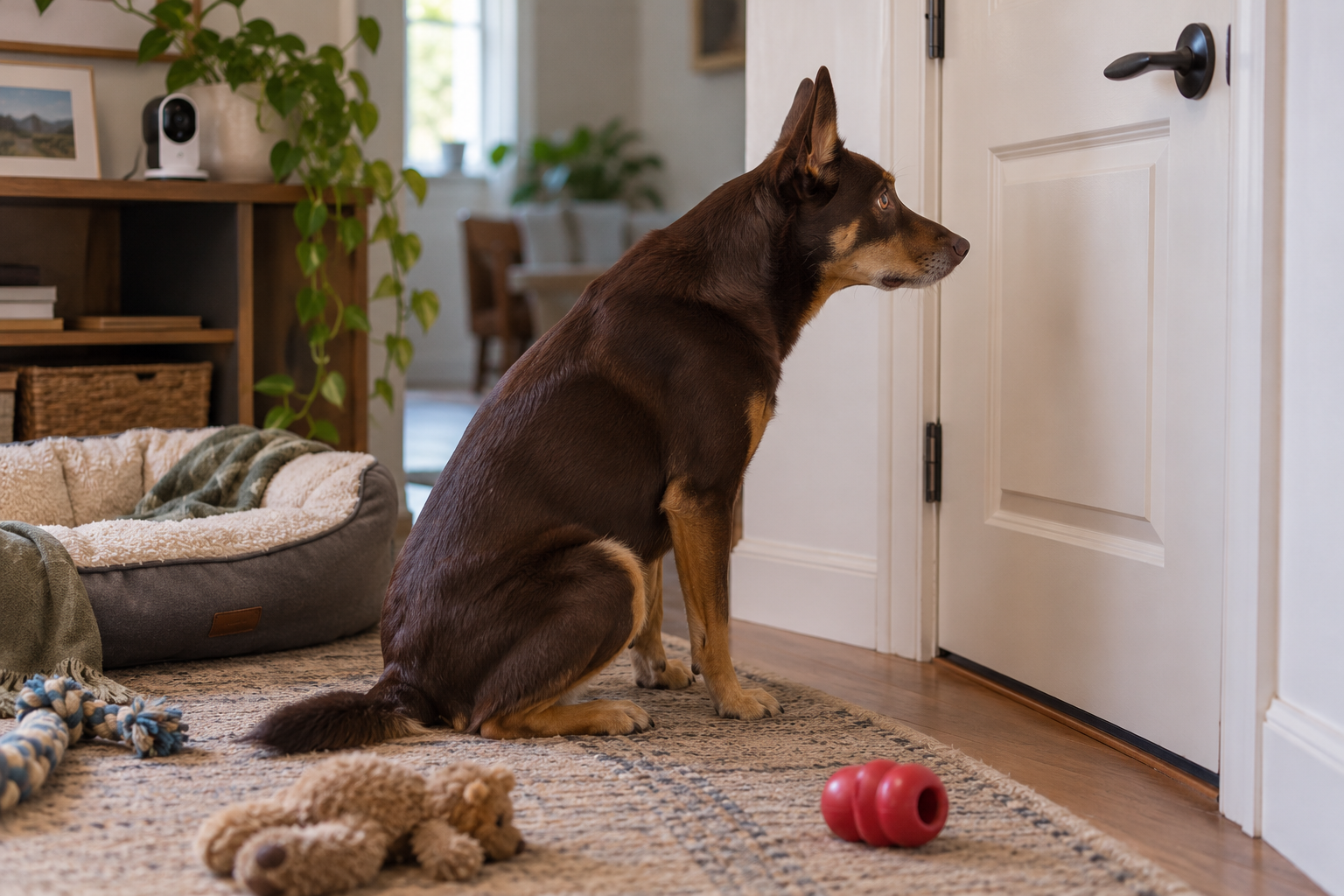
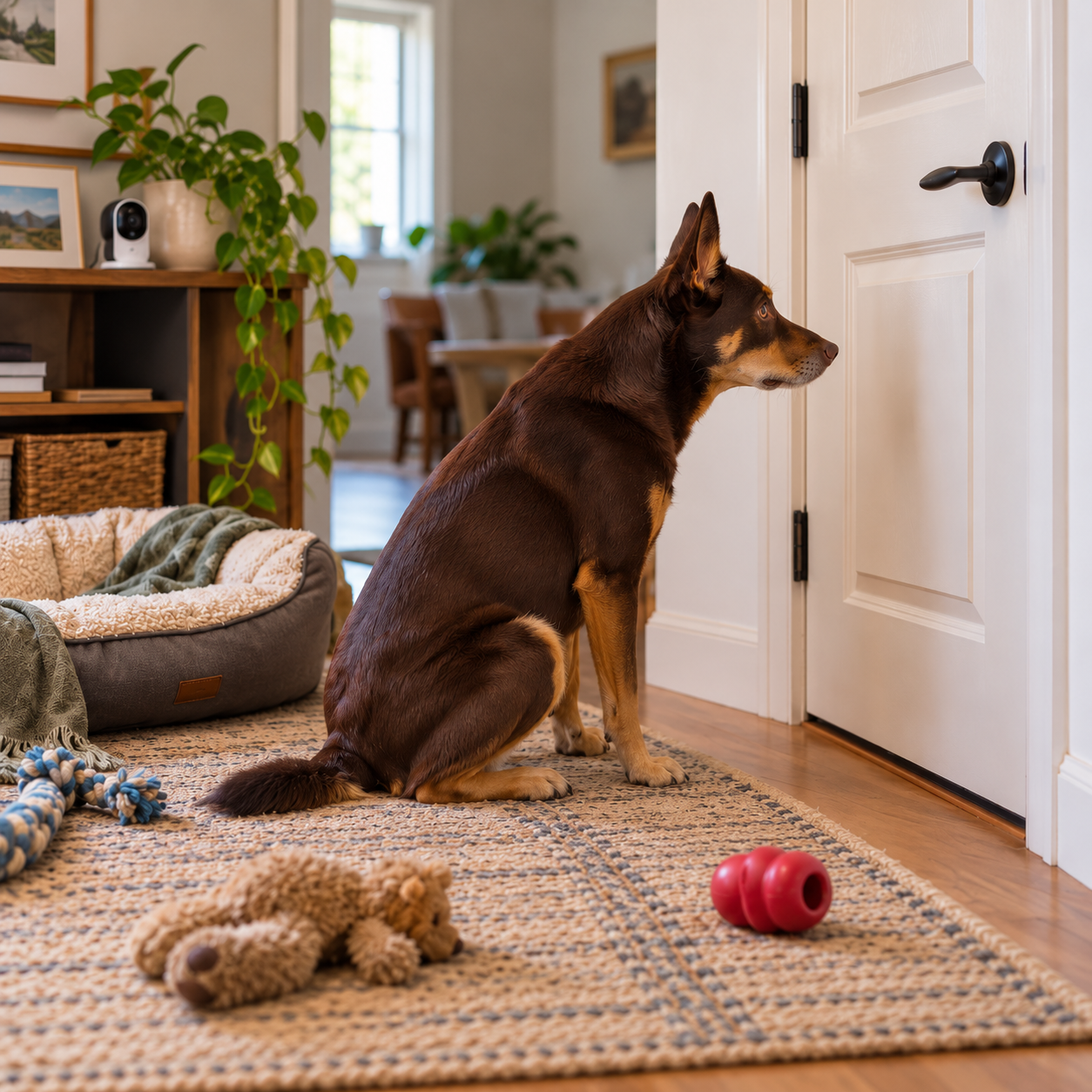
One of the most common problems dog owners face is a dog who barks and carries on when they leave the house.
But barking when you go out does not automatically mean separation anxiety. Some dogs are what CLEAR Dog Training informally calls Velcro dogs: they are used to having their person nearby and are distinctly unimpressed when that person disappears. Others are genuinely distressed by being left alone. Some are perfectly happy without you until the postie walks past, another dog appears outside or somebody makes a noise in the hallway. And some dogs have a bit of more than one going on.
Before trying to stop the barking, work out why it is happening.
Step one: put a camera on your dog
This is one of CLEAR Dog Training’s biggest tips. Don’t guess what happens once you close the front door. Find out.
Set up a camera and record your normal leaving routine and at least the first 30–60 minutes after you go. Does your dog bark for a while, wander around and then curl up and sleep? Does it remain distressed — pacing, panting, drooling, scratching at the door or repeatedly rushing to the exit? Or does it sleep happily until something outside sets it off?
A camera cannot diagnose separation anxiety, but it gives you the information needed to work out what sort of training and management plan is appropriate.
Velcro dog or separation anxiety?
A Velcro dog is generally capable of coping without you. It simply may not have learnt to be very good at it yet. These are often the dogs who follow their owners everywhere. You go into the kitchen: the dog comes too. You walk into the bedroom: there it is. You head to the bathroom and apparently even having a tinkle requires canine supervision.
It can be funny and rather endearing, but if your dog spends virtually every waking moment glued to you, it gets very little practice at being independent. For many of these dogs, barking when you leave is more protest than panic: you’ve gone out and they’re letting the world know they are not happy about it.
Genuine separation anxiety is different. A seriously anxious dog may pace continuously, pant or drool, refuse food, scratch or chew frantically at exits, toilet despite being house-trained or remain unable to settle. If your camera shows prolonged or severe distress, talk to your vet. In more serious cases, medication may be useful while you work through a carefully structured behaviour plan. Don’t simply leave an anxious dog to panic until it gives up, and never use a bark collar to suppress anxiety-driven barking.
Patricia McConnell’s I’ll Be Home Soon! is an oldie but a goodie and one of CLEAR’s favourite starting points for understanding genuine separation anxiety.
For Velcro dogs, start while you are home
If your dog follows you everywhere, don’t wait until you leave the house to teach independence. Make short, comfortable periods apart part of normal life. Baby gates are brilliant for this. Your dog might relax in the living room while you work elsewhere, spend some time in another part of the house or stay outside while you are inside if that suits your home and dog.
This is particularly valuable with puppies. Once they are settled and comfortable in their new home, start introducing short, easy periods apart. Being alone is a skill, and it is much easier to teach gradually than to spend every minute together for weeks and then suddenly expect a puppy to cope with hours alone.
Teach quietness before you need it
Another important part of the Velcro-dog picture is teaching that barking does not automatically make you spring into action.
This is incredibly easy to get wrong. The dog barks and, because you are worried about annoying the neighbours, you immediately respond: “Shush, darling, it’s all right.” From the dog’s point of view, it has put a coin in the slot — and you have started operating. It doesn’t necessarily matter whether you praised it, reassured it or told it to be quiet. Barking made something happen.
That is why calmness and quiet behaviour need to be rewarded throughout everyday life. One simple CLEAR exercise is Freebie. Toss a treat and say “Freebie!” When your dog eats it and comes back, toss another. If it jumps on you or demand barks for the next one, stop, fold your arms, remove eye contact and wait. When the dog is calm, the game starts again. Barking and pestering don’t make the fun happen; calm behaviour does.
This applies to demand or protest barking, not a dog that is genuinely frightened or panicking. Pick your battlegrounds carefully too. If your neighbour puts a baby down at three every afternoon, that is not the time to practise waiting out protest barking. Quieter periods may give you more room to train without feeling forced to respond to every sound.
Work with your dog’s natural rhythm
Timing can make an enormous difference. At CLEAR, these states are jokingly described as normal, cocktail-by-the-pool mode and ballistic-missile mode.
Don’t choose ballistic-missile mode to practise settling or short absences. If your dog is bouncing off the walls, you are making the job unnecessarily hard. If it normally crashes for a sleep after its morning walk, that may be the perfect time to practise settling behind a baby gate or being alone briefly.
Go with the flow and set the dog up to succeed.
Take the drama out of leaving
Some dogs begin reacting before you even reach the door. Shoes, keys, a work bag or a particular jacket can all predict that you are about to disappear.
Practise those things without leaving. Pick up your keys and put them down again. Put on your shoes and make a cup of tea. Break the sequence that tells your dog you are about to go, then start practising short, manageable departures. Keep them varied rather than making every absence longer than the last, and use the camera to make sure the dog is actually coping.
What if the problem is outside?
Sometimes the camera shows your dog watching you leave, curling up happily and going to sleep — until somebody walks past the window. Now you have a different problem.
Close blinds or curtains, move the resting area away from busy windows or doors and consider gentle background noise to soften outside sounds. You can also work on particular triggers while you are home, pairing low-level versions of the sound or sight with something the dog enjoys.
Make a change, check the camera and see whether it actually helped.
Find the reason, then make the plan
A dog barking when you leave is not a diagnosis. One dog may be objecting because its person has disappeared. Another may genuinely be panicking. A third may be sleeping peacefully until the postie walks past.
Get the camera out, look at the whole picture and build your plan around the dog in front of you. Practise independence and calmness when life is easy, choose your training times carefully and avoid accidentally teaching your dog that barking is the quickest way to get you back.