
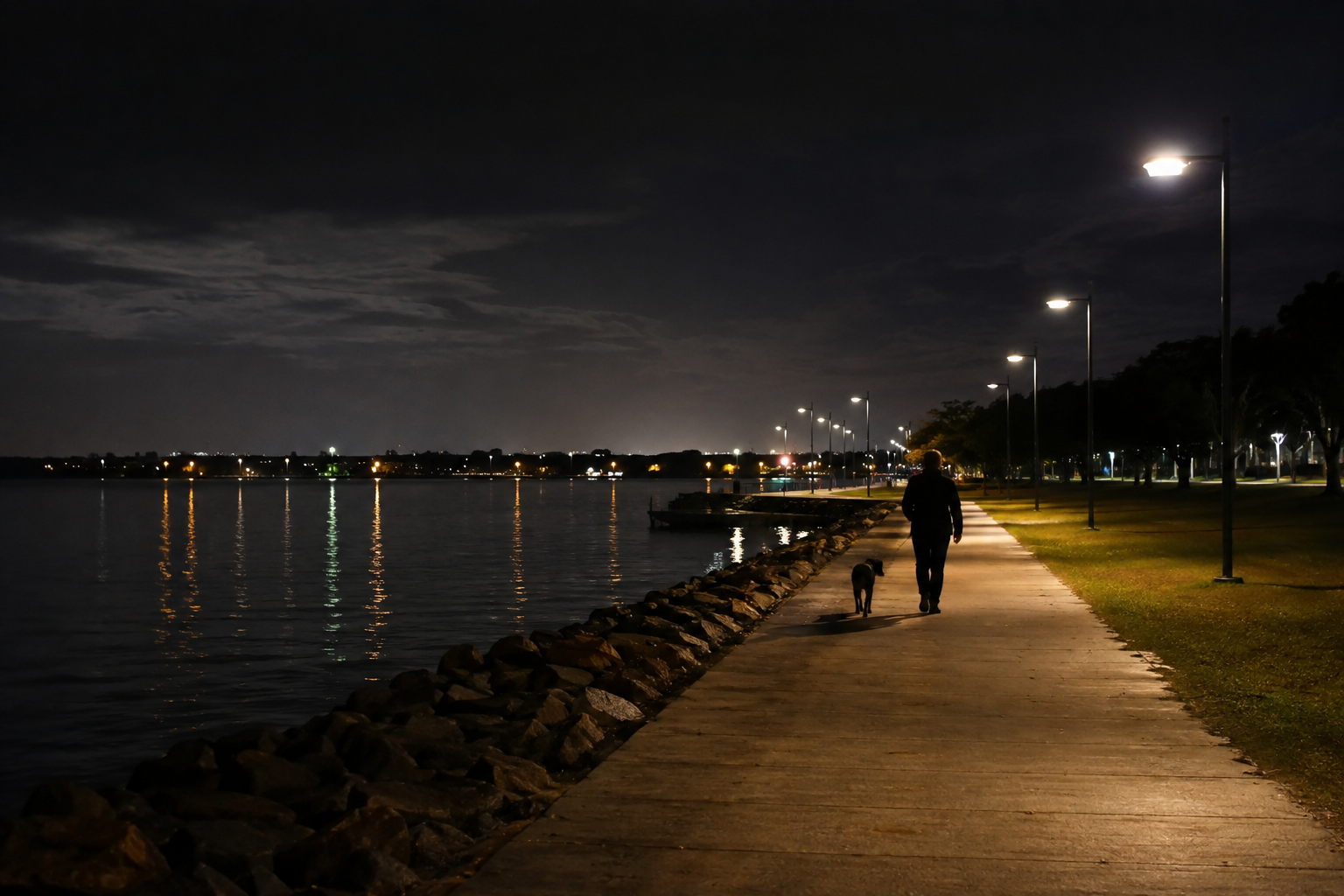
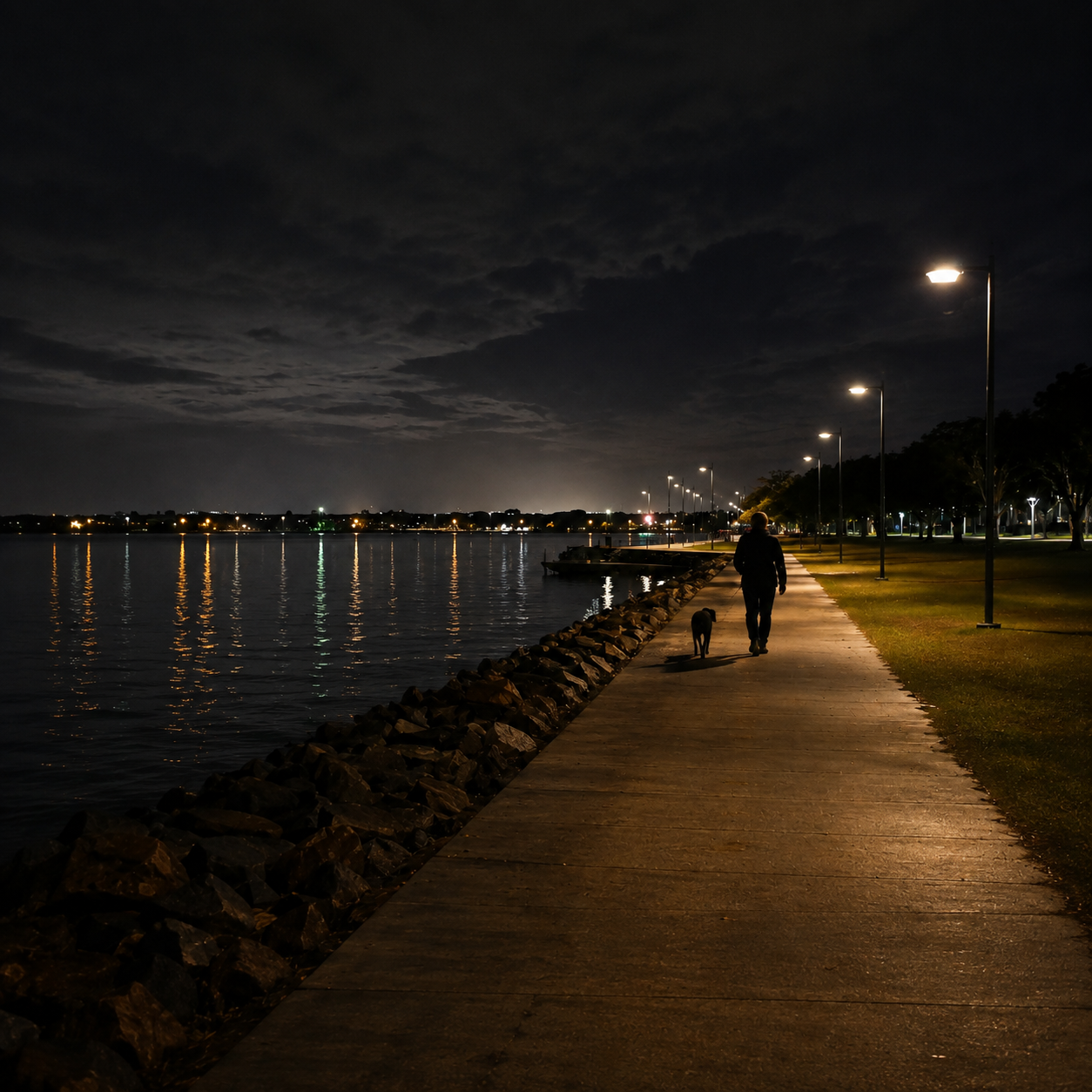
Most of us don’t think twice about taking the dog out early in the morning or after dark. It can be cooler, quieter and a lovely time to walk. But a recent incident at Wynnum was a reminder that a few basic safety precautions are worth thinking about.
A woman walking her dog near the Wynnum–Manly Leagues Club in Wondall Road at about 6am was reportedly threatened by a man carrying a stick. Fortunately, some nearby tradies came to her aid and drove her home.
Incidents like this are thankfully unusual, but many of us walk alone, particularly during Brisbane’s warmer months when early mornings and evenings are often the most comfortable times for dogs and humans alike.
So how can you make those walks a little safer without becoming paranoid about every stranger you meet?
Choose your route carefully
Where possible, stick to well-used streets, paths and parks rather than isolated shortcuts. Along the Wynnum–Manly waterfront, for example, some areas are busy even quite early, while others become deserted once you move away from the main paths.
Think about where you could go if you suddenly felt uncomfortable. An open service station, a busy road, a group of people or even a house with lights on could offer somewhere to seek help. A route with several escape options is generally safer than a secluded boardwalk or track with only one way in or out.
And don’t feel obliged to keep walking if something doesn’t feel right. Cross the road, turn around or head towards other people while there’s still plenty of distance between you and whoever is causing concern. You don’t need to wait until you’re certain there’s a problem.
Keep your eyes and ears open
It’s easy to switch off on a familiar walk, particularly when you’re enjoying a bit of peace and quiet. But it’s worth keeping an eye on what’s happening ahead and behind you.
Headphones can make it harder to hear somebody approaching, a bicycle coming up behind you or something else that needs your attention. Where practical and safe, walk facing oncoming traffic so you can see vehicles approaching.
Brief, natural eye contact with passers-by shows you’re alert and aware of their presence. But there’s no need to stare, smile or start a conversation.
If somebody approaches aggressively, don’t get drawn into an argument or feel obliged to answer their questions. Keep your distance and move towards somewhere safer. You don’t owe a stranger an explanation for crossing the road or walking away.
A small torch or headlamp is also useful on poorly lit paths, both for seeing where you’re going and making yourself more visible.
Don’t be afraid to make a noise
If somebody threatens you or approaches aggressively, shout for help and attract as much attention as possible. There’s no prize for being polite when you feel threatened.
Someone intending to intimidate a person walking alone may be far less comfortable once nearby residents, motorists or other walkers start looking in their direction.
A simple whistle is worth considering. It’s cheap, lightweight, needs no batteries and won’t accidentally go off if you drop it. Choose a loud whistle and keep it somewhere you can reach quickly, rather than buried in the bottom of your handbag. Its main limitation is that you need to be able to get it to your mouth and blow it.
CLEAR owner Caroline Strainig recently bought a small personal alarm with a built-in torch from Jaycar. At around $15, its ear-splitting 130dB alarm seemed a sensible precaution.
But there’s a catch. Caroline discovered that the pull-ring alarm is surprisingly easy to activate accidentally. Attach it to your keys or handbag and you can set it off simply by fishing around for your keys or pulling them out. Drop it, and you may find yourself making a spectacular amount of noise without meaning to.
It’s still a useful little gadget, but think carefully about where you carry it. A whistle may be a simpler, less troublesome alternative, although neither option is perfect.
Take your phone and tell someone where you’re going
Even if you’re only walking around the block, take your phone, make sure it’s charged and keep it somewhere accessible.
If you’re heading somewhere particularly quiet, let somebody know your route and when you expect to be home. Even a quick message saying you’re walking along the waterfront and should be back by seven gives someone a starting point if you don’t return as expected.
Location sharing on your phone can also be useful. In an emergency, call Triple Zero (000). Many smartphones also have an Emergency SOS feature that can alert your nominated emergency contacts and share your location when you use it to call for help.
This is available on iPhones and many Android phones, but the features and settings vary. Add your emergency contacts and check how it works on your phone before you need it. Don’t assume that simply dialling 000 will automatically notify them.
Watch out for loose dogs
People aren’t the only potential hazard. Loose dogs can be a real problem in suburbia, particularly where fencing or gates aren’t secure. Keep an eye out for dogs wandering the street or coming out of driveways, and if you spot one ahead, change direction while there’s still plenty of distance between you.
If a dog approaches aggressively, resist the temptation to yell at it, stamp your feet or try to frighten it away. Stay calm, avoid staring directly into its eyes and don’t make sudden movements. If it’s already close and threatening, don’t run. Stand still initially if necessary, then move away slowly when it’s safe to do so.
RSPCA Australia recommends avoiding confrontation wherever possible and putting a barrier, such as a parked car, fence or hedge, between you and an unfamiliar dog. If dogs are already fighting, don’t try to separate them with your hands.
CLEAR also recommends carrying a handful of tasty treats. RSPCA Queensland suggests throwing high-value treats such as chicken or cheese towards an approaching dog, which may distract it long enough for you and your dog to get away. An umbrella can also be useful, both as a visual barrier and to discourage a dog from coming closer.
Another option is to duck into a nearby yard if you can do so safely, but check first that there isn’t another dog waiting inside!
Caroline also carries PetSafe SprayShield, a citronella-based animal deterrent designed for situations involving aggressive dogs. It produces a concentrated spray reaching up to three metres. Directed towards the approaching dog’s nose, the strong smell may startle or distract it long enough for you to retreat.
It’s not guaranteed to stop a determined attack, and it’s important to avoid spraying directly into the eyes. Like any deterrent, it’s a backup rather than a substitute for spotting potential trouble early and keeping your distance.
Your dog may help, but don’t rely on them
Having a dog beside you may make some people think twice about approaching, particularly if it’s a big one. But even a large dog isn’t a personal protection system, and expecting your dog to confront someone could put both of you in danger.
Your best options are to notice potential trouble early, keep your distance, attract attention if necessary and move somewhere safer.
A little forethought can make all the difference if you ever find yourself in an uncomfortable situation. Knowing where to go, how to attract attention and when to walk away gives you a much better chance of getting yourself and your dog safely home.
And hopefully the most exciting thing you’ll encounter on your next early morning walk will be a particularly interesting smell your dog insists on investigating.
Much of the personal safety advice in this article is drawn from the Queensland Police Service’s Adult safety guidelines. Advice on dealing with unfamiliar or aggressive dogs is also available from RSPCA Australia and RSPCA Queensland.