Give yourself a point for each one that sounds familiar and see just how well your dog has trained you. Come on now. Be honest.
We spend an enormous amount of time talking about how to train dogs: sit, stay, come, walk nicely, settle down. But there is another side to the relationship that perhaps doesn’t receive quite as much attention. Dogs train us too — and some of them are extremely good at it.
And nobody is immune. Even at CLEAR, we occasionally find ourselves looking at something one of our own dogs is doing and thinking, “Oh, really? How did that happen?” Trace it backwards and there’s often the answer: somewhere along the way, the dog has trained us beautifully.
How did that happen?
Dogs are brilliant at noticing patterns. If doing A reliably makes a human do B, there is every chance they’ll try A again. Sometimes, without realising it, we create a little sequence in which something we don’t particularly want becomes the first step towards something the dog very much wants. Trainers call this an accidental behaviour chain.
Here are eight we see regularly. Give yourself a point for each one that sounds familiar.
1. Jumping jackpot
Jump up → get told to sit → get a treat
You think you’re rewarding the sit. Your dog may have discovered a beautifully reliable system: jump first, sit second, collect payment.
Try instead: Reward your dog while all four feet are still on the ground. At CLEAR, we build impulse control into many of our relationship games: jump, bark or get rude and the fun stops; settle down with four feet on the ground and the game starts again. Being rude stops the fun — staying grounded keeps it going.
2. Room service
Bark outside → get called in → get a treat
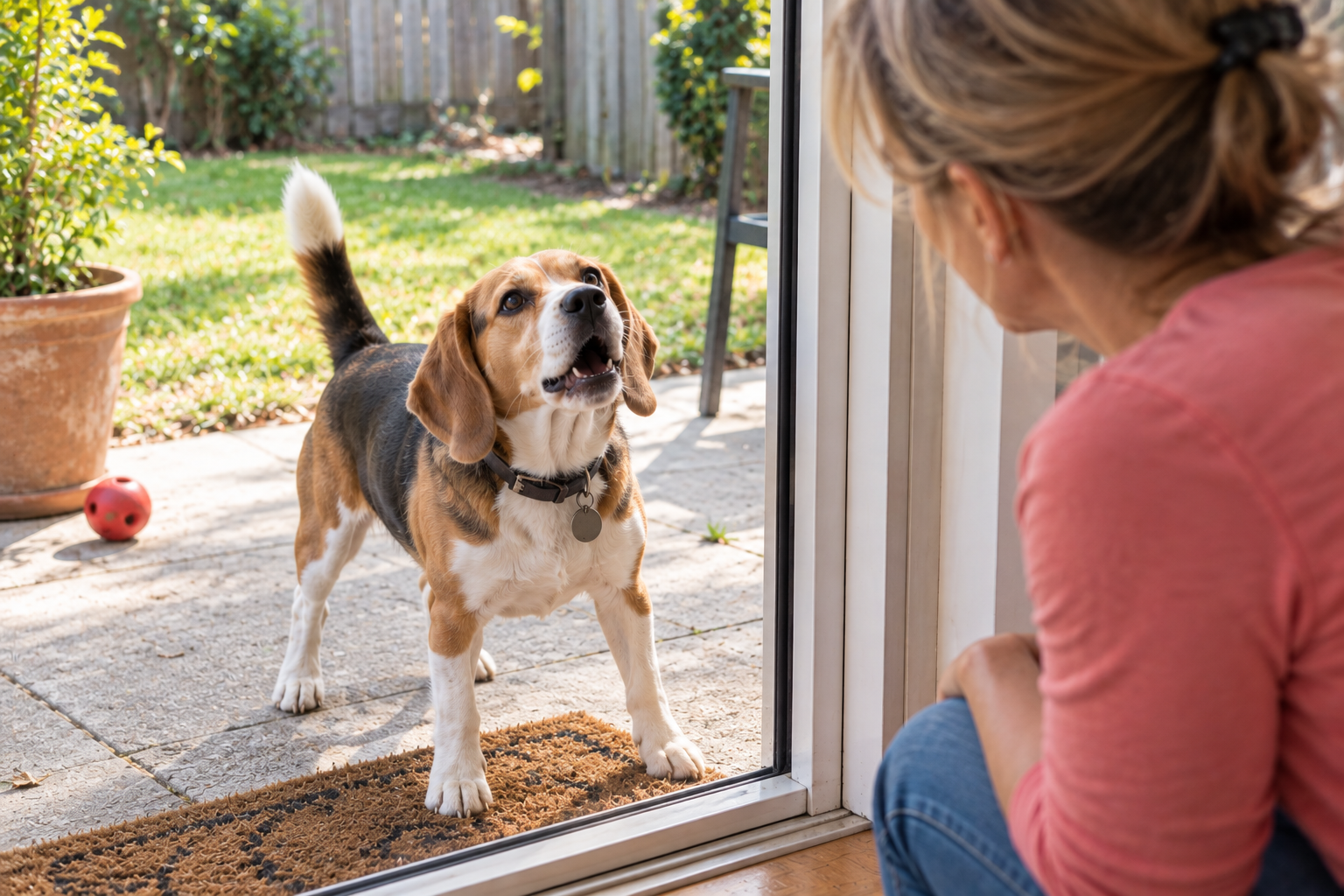
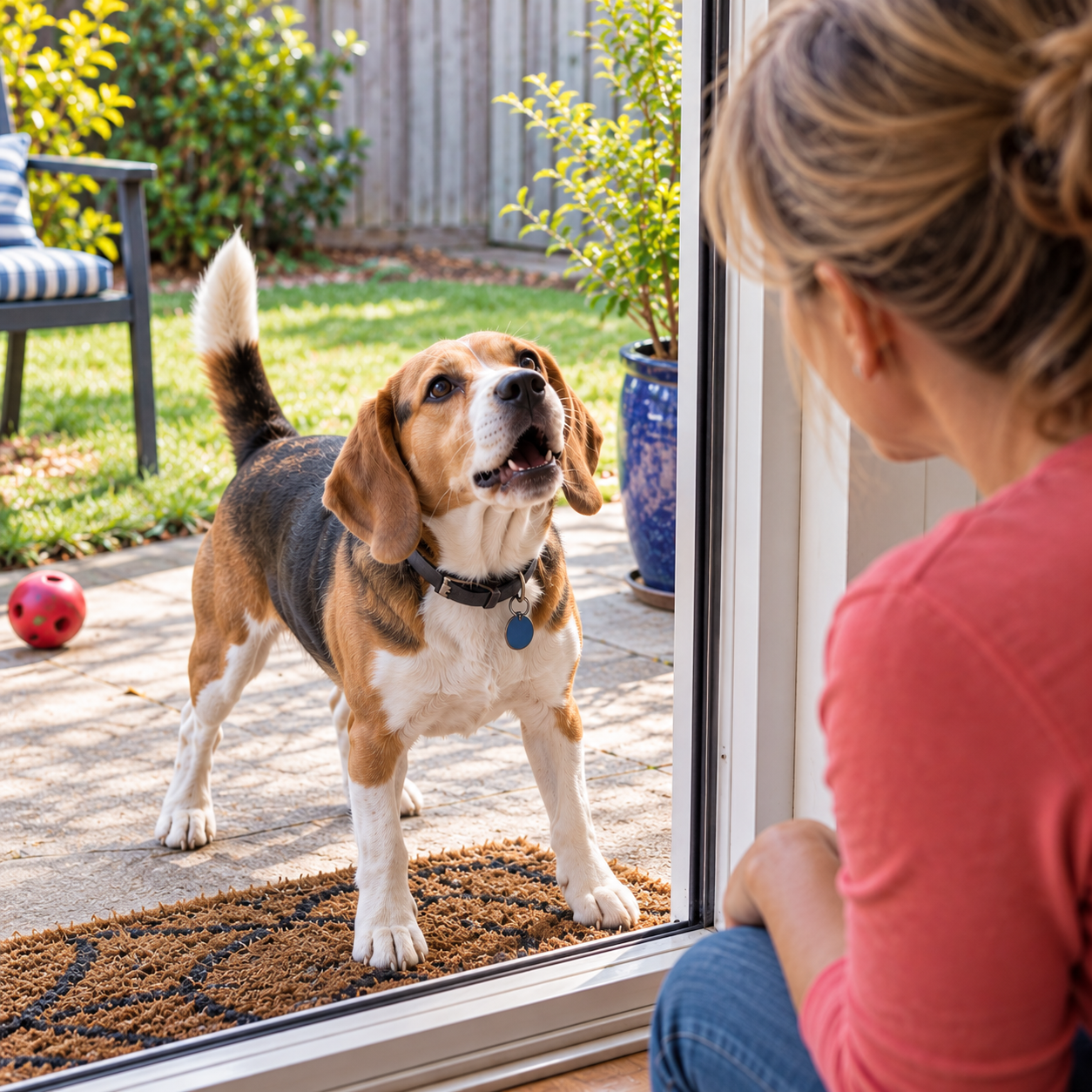
We’ve seen this one in action. A client was having trouble with his Beagle barking in the backyard, so we asked him to show us what happened. Out went the dog. Bark, bark, bark. The owner called him in, walked to the pantry, opened the cupboard and gave him a treat for coming.
Mystery solved. As far as that Beagle was concerned, barking was apparently how you got the treat cupboard opened. Beagles, it must be said, can be exceptionally talented at training their humans.
Try instead: Don’t make barking the cue for a well-paid recall. If you do call your dog, absolutely reward it for coming — we never want coming to you to end badly. But if barking routinely starts the whole sequence, change the sequence. Get the dog in before the barking starts, or go out and interrupt it rather than standing at the door calling and heading for the treat cupboard.
3. Toy dispenser
Bite hands or ankles → human produces toy → game begins
An easy one with puppies. Puppy gets mouthy, tug toy immediately appears and the previously boring human becomes tremendous fun. Bite human, activate entertainment system.
Try instead: Don’t wait for the teeth. Initiate games when the puppy is playing appropriately, and if teeth hit skin or clothing, pause the interaction. Once the puppy settles, the fun can start again. Same message: sensible behaviour keeps the game alive.
4. Ball launcher
Drop ball → bark at human → human throws ball
You may believe you’re playing fetch. Your dog may believe it has successfully installed a voice-activated ball thrower.
Try instead: If barking makes you throw the ball, barking is working. Wait for quiet before the game continues — and sometimes surprise your dog by starting the game yourself when it is relaxed rather than waiting to be ordered into action.
5. Breakfast alarm
Whine, paw or stare → human gets up → breakfast arrives
One little whine at 6 am becomes 5.45, then 5.30, and before long the dog appears to be in charge of daylight saving. Why wait for an alarm clock when you can operate the human directly?
Try instead: Don’t let pestering be the signal that starts breakfast. Get up and start the morning when the dog is settled, even if that means waiting for a brief patch of quiet before you move. Otherwise 5.30 has an alarming habit of becoming 5.15.
6. Chicken-powered walk
Stop walking → human coaxes → chicken appears
A classic with puppies — and Golden Retrievers seem particularly capable of perfecting the art of becoming completely immovable. Puppy stops, human coaxes, puppy remains planted, chicken appears. Puppy walks a few metres and stops again. At some point you have to ask who is actually training whom.
Try instead: Use the chicken while the puppy is moving, not only after it has stopped. Reward a few nice steps, keep things easy and interesting, and finish before a tired or overwhelmed puppy has had enough. Make walking the thing that produces the chicken.
7. Better offer
Ignore the recall → wait → human improves the deal
You call. Nothing. You call again. Still nothing. Eventually out comes the chicken, favourite ball or squeaky toy. Your dog may simply have learnt not to accept the opening offer when negotiations usually produce a better one.
Try instead: Don’t keep repeating the cue and sweetening the deal. Set up recalls you have a good chance of getting, make responding worthwhile, and practise when there isn’t something vastly more exciting competing with you. We want the first call to matter.
8. The sock chase
Steal something forbidden → human chases → fabulous game begins
Nothing turns a boring sock, tea towel or pair of underwear into treasure quite as effectively as a human leaping out of a chair shouting, “Give me that!”
Try instead: Resist the chase. Teach a good swap or drop separately, exchange the stolen treasure calmly when necessary and, especially with puppies, manage the environment so the world isn’t full of irresistible things to steal. A sock is much less exciting when nobody joins in the game.
So, how did you score?
0–2: Congratulations. You appear to be training your dog.
3–4: There has clearly been some negotiation over the terms and conditions.
5–6: Your dog has moved into middle management.
7–8: Congratulations. Your dog is a master manipulator. Please report to reception for your performance review.
Breaking the chain
First, don’t feel bad. We all do it. Even experienced trainers occasionally need to stop, look at what is happening and have an “Oh, really?” moment when we realise exactly what the dog has learnt.
Once you spot the pattern, changing it is often surprisingly simple. Look for the behaviour you want and make that the thing that works. Reward the puppy while it is walking rather than after it stops. Keep the game going while four paws are on the floor rather than restarting it after a jump. Start the fun when the dog is behaving nicely rather than waiting for it to demand your attention.
None of this means never redirecting a puppy with a toy, using chicken on a walk or rewarding a recall. It simply means keeping an eye on the sequence you may accidentally be teaching. Every now and then, ask yourself: What did my dog just do that made me do this?
If the answer is “something I wish they wouldn’t do”, you may just have found the first link in the chain.
And if your dog is watching you read this, it already knows you’re onto it.