
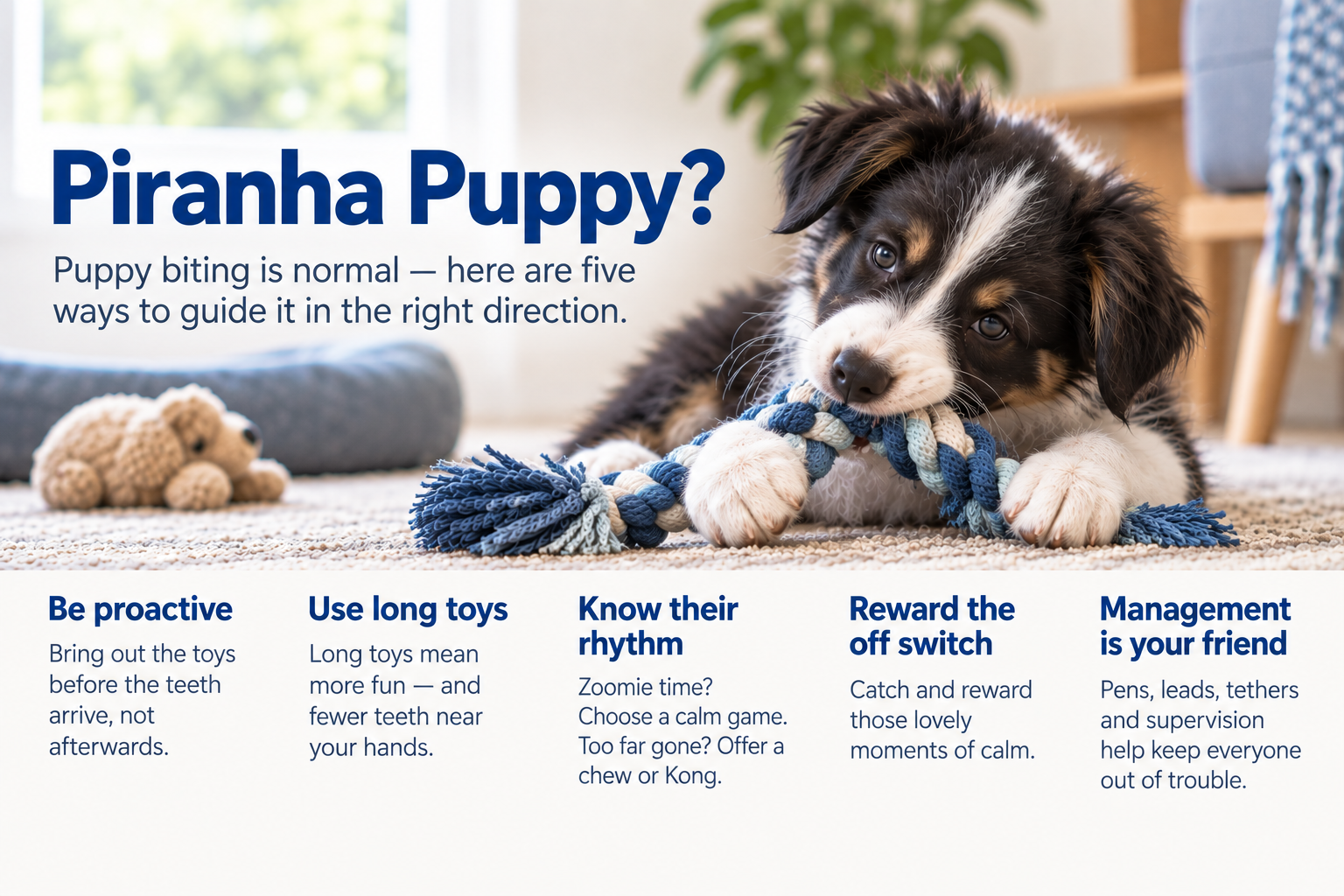
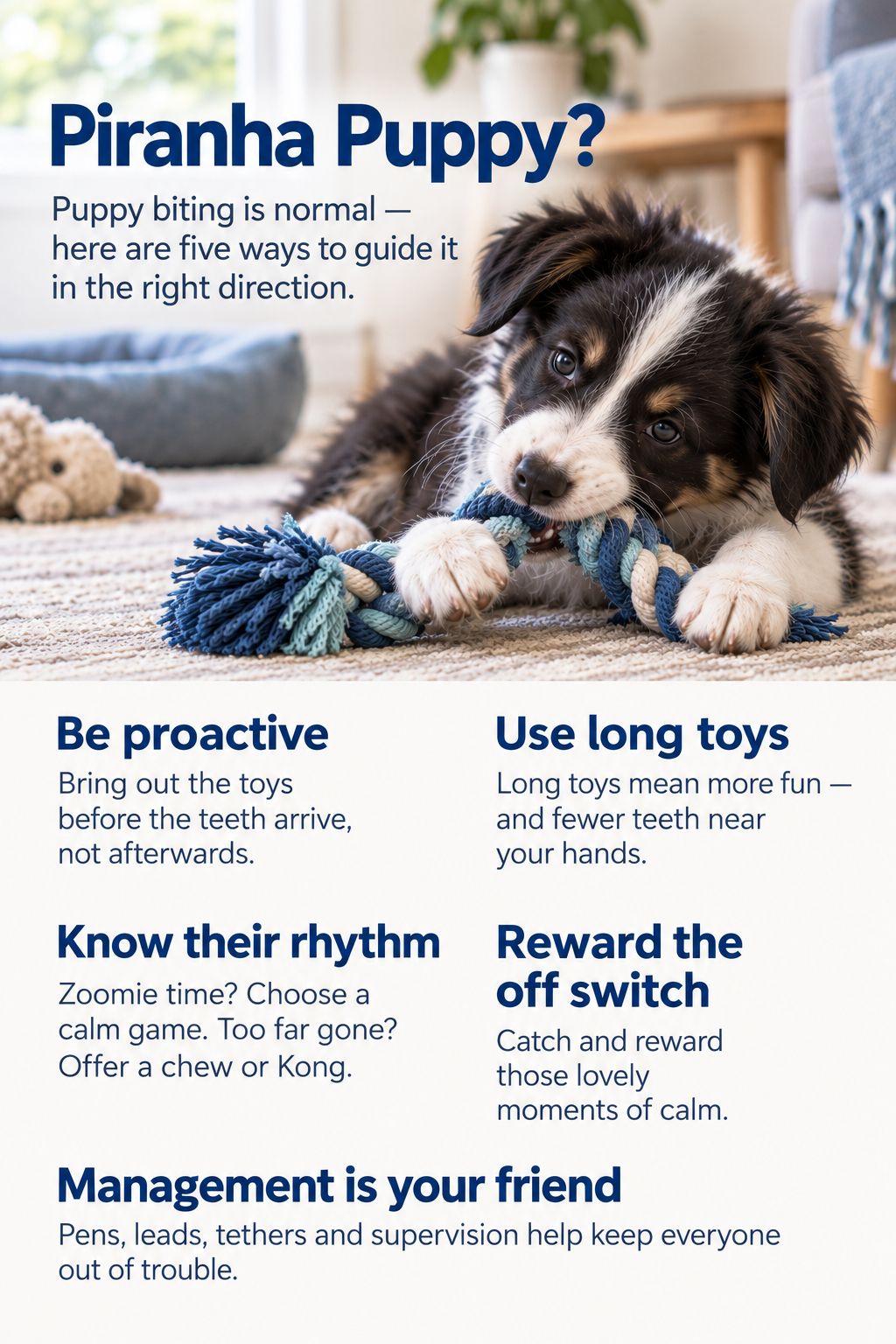
“I feel like I’ve adopted a piranha!” If that sounds familiar, you are far from alone. Puppy biting is one of the most common issues raised by new owners — and while it is usually a completely normal stage of puppy development, that doesn’t make it enjoyable.
Puppies explore the world with their mouths. They grab, chew and play-bite, particularly while teething. The aim isn’t to expect a baby puppy never to use its mouth. It’s to help them develop a softer mouth, learn what is appropriate to chew and, eventually, understand that human skin is off limits.
And preferably without sacrificing every pair of trousers you own along the way.
Learn your puppy’s modes
Puppies tend to cycle through different levels of arousal during the day. At CLEAR Dog Training, we sometimes describe the two extremes as cocktail-by-the-pool mode and ballistic-missile mode.
Get to know which puppy you have in front of you. If yours is in full ballistic-missile mode, it’s probably not the moment to sit on the floor hoping for a quiet cuddle. That may be the time for an appropriate game, a chew, a little training or some calm management.
It’s also worth asking why the puppy has gone feral. They may need something to do — but they may equally need less. Overtired puppies can become extraordinarily bitey, and piling more activity onto an already overstimulated puppy can make things worse.
We’ve found a balance of age-appropriate exercise, sniffing, short training sessions, food puzzles, simple games, chewing and plenty of sleep works well for many puppies. Exercise the brain as well as the body, but don’t forget the off switch. Naps matter.
Give those teeth somewhere useful to go
Teething puppies need to chew, so give them plenty of appropriate outlets. Rotate safe chew toys and offer different textures rather than expecting a puppy surrounded by tempting shoes, chair legs and human ankles to make consistently brilliant decisions.
Toys are useful for play too, but timing matters. One mistake we often see is waiting until the puppy bites and then immediately producing an exciting toy. The intention is perfectly sensible — redirect the puppy onto something appropriate — but an enterprising puppy may discover that biting the human makes the fun begin.
Where possible, get in first. Start the game before the puppy launches onto your hands, clothes or ankles. A tug toy attached to a rope can be particularly useful: drag it along the ground so the puppy can chase, grab and tug while your hands stay well away from those needle teeth. It gives the puppy an appropriate target without putting human skin in the middle of the game.
We’re also not great fans of hand games. Encouraging a puppy to chase fingers or grab hands can be funny when they’re tiny, but it can blur the distinction between toys and people. Even sitting on the floor at puppy level can trigger rough puppy-on-puppy style play in some youngsters. If your puppy gets overexcited easily, think about what you are doing as well as what the puppy is doing.
Teach calmness — and a softer mouth
Don’t concentrate so hard on tiring your puppy out that you forget to teach them how to do nothing. Calmness is a skill too.
One approach we’ve found useful is a simple settle exercise. Sit quietly with the puppy on lead beside you, with a foot resting partway up the lead so they can move and settle but can’t endlessly wander, leap on you or rehearse biting. Wait for the puppy to soften or relax, then quietly reward that calmer behaviour. With some setups, looping the lead around a sturdy object and back to your hand can provide extra control while still allowing you to release it quickly if necessary.
Reward calmness elsewhere too. A puppy lying quietly, choosing its own toy or simply watching the world without creating havoc is doing something worth noticing. We can become so focused on unwanted behaviour that the puppy gets most of our attention when it is being a ratbag.
Bite inhibition is important as well. Young puppies need to learn not only what they may bite, but how to control the force of their mouths. If a puppy bites too hard, one approach is a calm “ow” or “too hard”, followed by briefly ending the interaction. Some puppies respond well to this. Others find squealing enormously exciting and come back for another go, so work with the puppy in front of you. The point isn’t punishment or drama. It’s simply that hard biting makes the fun stop.
If the teeth keep coming, sometimes the simplest response is to end the interaction altogether. We jokingly call it “winning a prize”. Behaving like a dingbat? Congratulations — you’ve won a brief trip outside or some quiet time in your pen. Once the puppy has settled, you can re-engage and see whether they can play more gently. Sometimes that brief break helps the puppy make a better choice; sometimes an overtired or over-aroused puppy simply needs help switching off.
As the puppy matures, you can gradually expect gentler behaviour until teeth on human skin are no longer part of the game. With a very young puppy, though, teaching a softer mouth may be more realistic than expecting perfection overnight.
Make handling a good thing
Puppies also need to learn that human hands approaching them aren’t something to dodge, fear or bite. Practise gentle handling when your puppy is relaxed rather than already wound up. Briefly touch paws, ears and the collar and pair the experience with something the puppy likes.
A useful collar exercise is to offer a treat at nose level while gently touching or taking hold of the side of the collar, then release. Avoid swooping down over the puppy like a bird of prey. We want hands coming towards the face and collar to predict good things, not suspicion.
There are various approaches to discouraging puppy biting, including physically holding the muzzle or making biting uncomfortable. At CLEAR, these aren’t methods we choose to use. We prefer to teach puppies that hard biting makes interaction stop, while gentle play and appropriate chewing keep the good things happening. We also want puppies to develop positive associations with hands approaching their face, mouth and collar rather than learning to avoid them.
Management is your friend
Much of successful puppy raising is being proactive rather than spending the entire day reacting to whatever the puppy has just done. Pens, baby gates, leads, crates and supervision can all help prevent a puppy rehearsing biting, zooming and general chaos when they’re over-aroused. Remove things you don’t want chewed and make appropriate choices easy.
Watch for patterns too. If your puppy turns into a piranha at roughly the same time every evening, you have useful information. Try changing what happens before that point rather than waiting for the teeth to arrive.
For most puppies, this stage passes. With maturity, sensible management and consistent training, those needle teeth gradually become less central to family life. If biting seems unusually intense, is escalating, involves concerning body language or is making life genuinely difficult, getting experienced help early is worthwhile.
Your puppy is highly unlikely to still be launching at your shoelaces as a pensioner.
Until then, management is your friend. And shoes without laces are not the worst idea either.
Need hands-on help?
Sometimes a little one-on-one help makes all the difference. CLEAR offers practical, personalised dog training across Wynnum–Manly and Brisbane Bayside, tailored to you and your dog.