
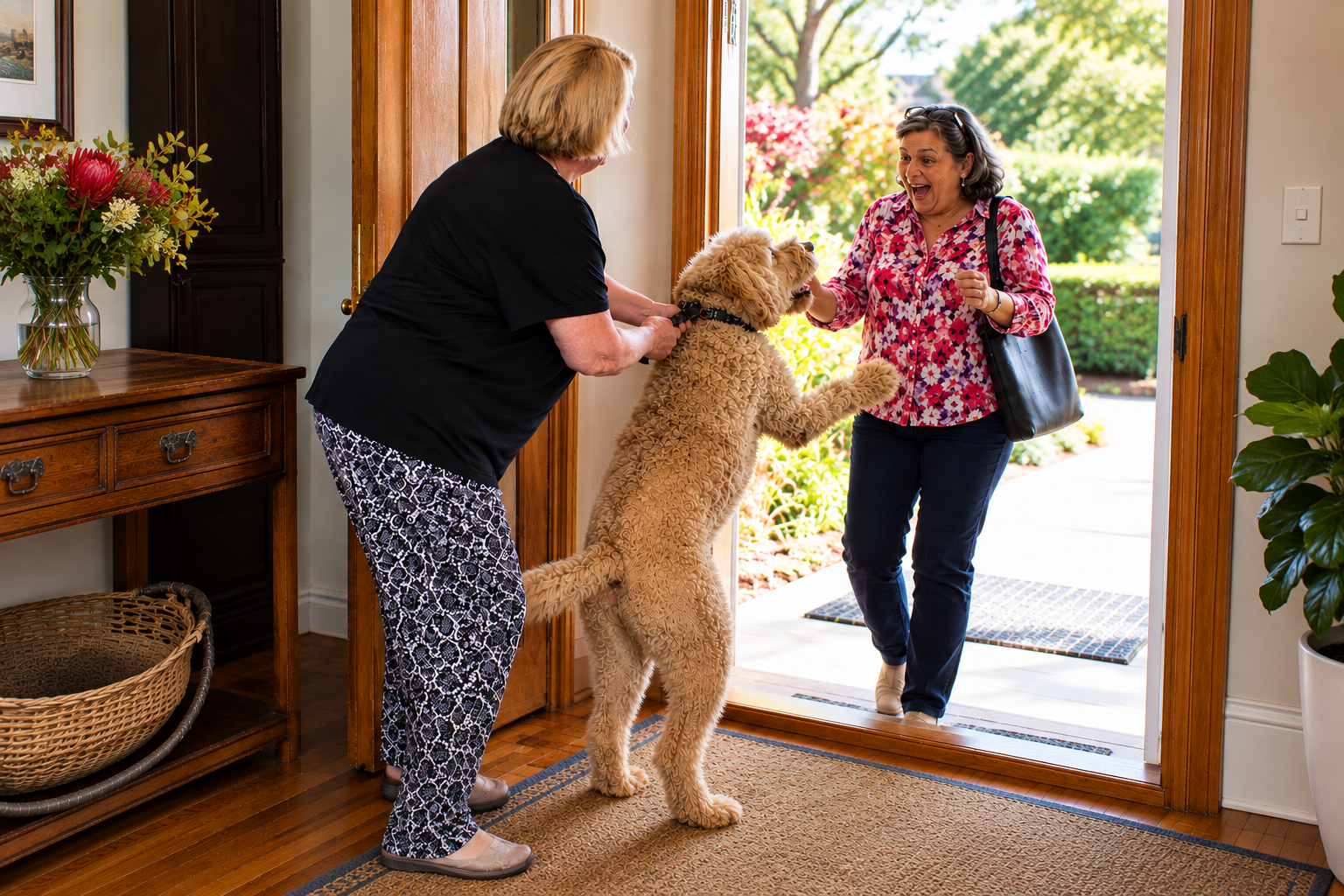
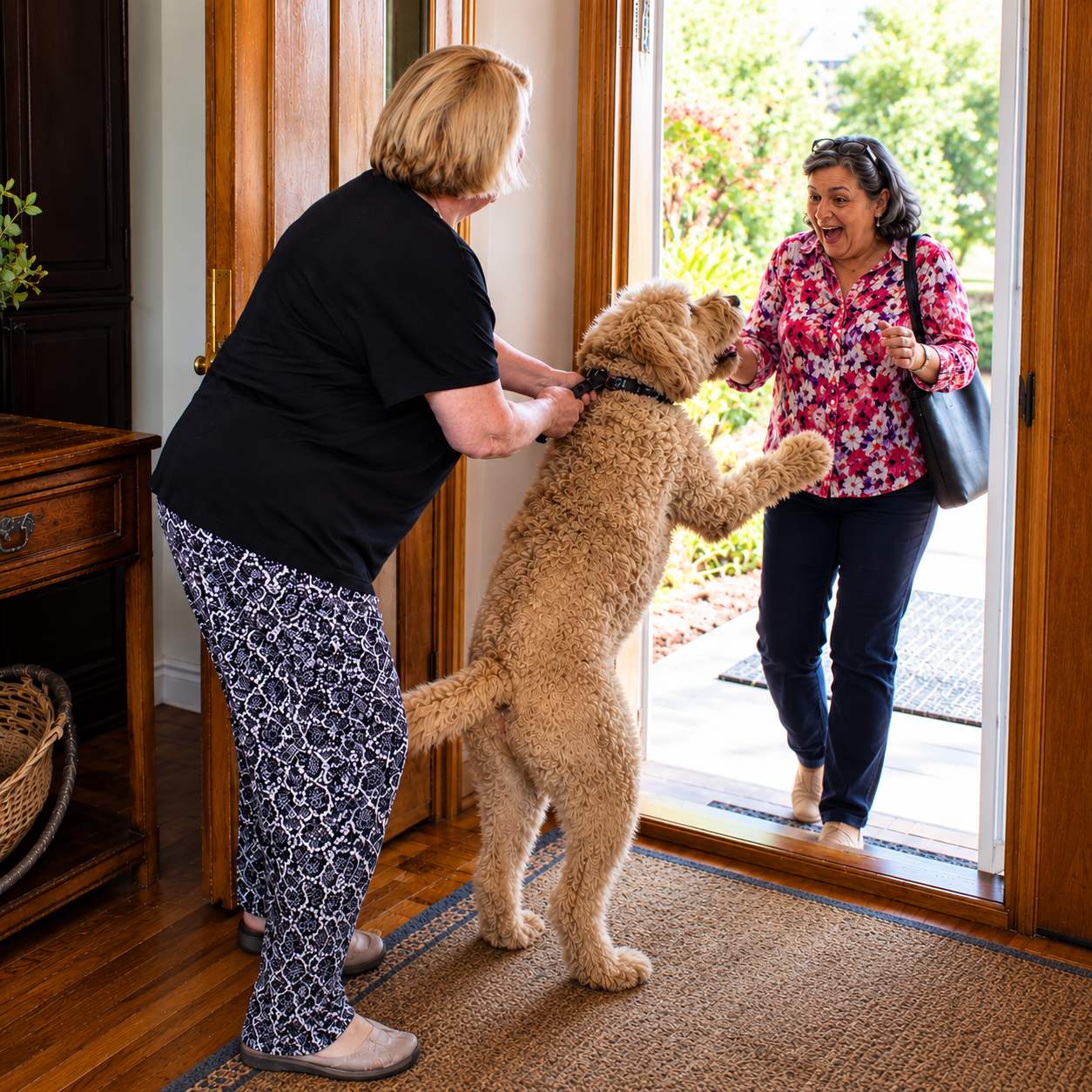
The doorbell rings and your previously sane dog goes straight into missile mode — barking, bouncing and launching. Before you know it, there’s a dog on your front and a tongue in your face. Sound familiar?
Visitor excitement is one of the most common problems CLEAR Dog Training sees. Usually, the dog isn’t being “bad”. It’s simply too excited to think. The answer is to stop waiting for the missile to launch.
A quick but important distinction: this article is about friendly dogs who think visitors are the best thing since sliced bread. If your dog barks, lunges or reacts to visitors through fear or anxiety, take extra care and don’t put it in a position where it can reach visitors or keep rehearsing that behaviour. Careful management, counter-conditioning and a more extensive training program may be needed, and help from an experienced trainer is advisable.
Management first: prevent the launch
If your dog routinely acts like a nut — albeit a friendly nut — when somebody arrives, stop having it at the front door while you try to greet people. Go back to one of the cardinal rules of dog training: management. Prevent the dog from repeatedly practising the behaviour you’re trying to change.
Instead, develop a completely different routine. Doorbell rings, lead goes on and the dog goes with you to another area of the house where something good is waiting. Scatter a handful of treats for it to find, give it a favourite chew or provide another enrichment activity while your visitor comes inside and settles.
That removes the dog from the most exciting part of the event and gives its arousal level a chance to come down.
Keep a lead handy near the front door for unexpected visitors. If somebody knocks, call through, “Just a moment — I’ll put the dog away,” clip on the lead and calmly take your dog to its preferred area. No chasing, no repeated recalls and no argument at the front door.
Of course, if it turns out to be a burglar, you may decide to leave the dog exactly where it is.
Train the routine before you need it
Don’t wait until Auntie Margaret is standing at the front door to try this for the first time.
Choose the room or area you want your dog to go to and make it somewhere it already enjoys spending time. Feed it there occasionally, give chews there, scatter treats for it to find or provide a favourite enrichment activity.
For CLEAR clients, the Freebie game is ideal: give the Freebie cue, toss a treat and let the dog happily chase and find it. Build a strong history of good things happening in that area when there isn’t a visitor anywhere in sight.
Then rehearse the whole sequence. Ask your partner or a friend to knock on the door. Lead goes on, dog goes to its area, treats are scattered or a chew appears, and the pretend visitor comes inside.
Repeat it at quiet times until the routine becomes familiar. You’re teaching a behaviour, not trying to improvise one when your dog is already shouting, “SOMEONE’S HERE! SOMEONE’S HERE!”
The lead matters for another reason. If your dog desperately wants to greet the person at the door, don’t stand there calling, “Come! Come! COME!” when you already know it probably won’t. Every ignored recall is practice at ignoring your recall.
Clip on the lead and set up the win instead. Lead on, away from the door, good things happen.
Lower the temperature before saying hello
Your dog doesn’t need to reappear 30 seconds after the visitor comes in.
Let it enjoy its chew or scatter while the visitor settles and the initial excitement subsides. Ten minutes later, you may have a very different dog. If you don’t, leave it happily where it is for longer.
The goal isn’t for your dog to greet every person who walks through the door. It’s for the dog to learn to cope calmly with people coming into the house.
Before bringing the dog back, brief your visitor. “He gets very excited around visitors. When he comes in, could you say hello quietly, give him one little stroke if he’s comfortable with that, then mostly ignore him for a few minutes?”
Dog-loving visitors can find the ignoring bit surprisingly difficult, but squealing the dog’s name and vigorously patting it is an excellent way of relaunching the missile.
And if somebody genuinely doesn’t like dogs, leave your dog happily occupied elsewhere. Not every visitor needs to become a training exercise.
Teach calm before you need it
Another useful skill is the settle exercise taught to CLEAR clients.
With your dog on lead, put your foot on the lead at a length that allows it to sit, stand or lie comfortably but prevents it from wandering off or launching itself at somebody. Then wait.
The moment your dog begins to soften and relax, quietly place a treat on the ground. No excited praise or big performance — you’re simply rewarding calmness.
Start somewhere boring and gradually practise in more interesting places. Once your dog understands the exercise, it can become a useful tool around visitors.
If it is safe and appropriate for your dog, you can also keep a foot on the lead when first introducing it to someone, giving enough freedom to stand comfortably and say hello without enough launch room to land on their chest.
There is no single magic exercise that fixes visitor excitement. The pieces work together: prevent the explosion at the door, train a happy routine for moving away, lower the arousal before introductions, brief visitors and teach calmness separately.
Practise with family and willing friends rather than waiting weeks for a real visitor and hoping for the best. With enough successful repetitions, the doorbell gradually stops meaning, “THIS IS THE MOST EXCITING THING THAT HAS EVER HAPPENED!”
And your coffee has a fighting chance of staying in the cup.