
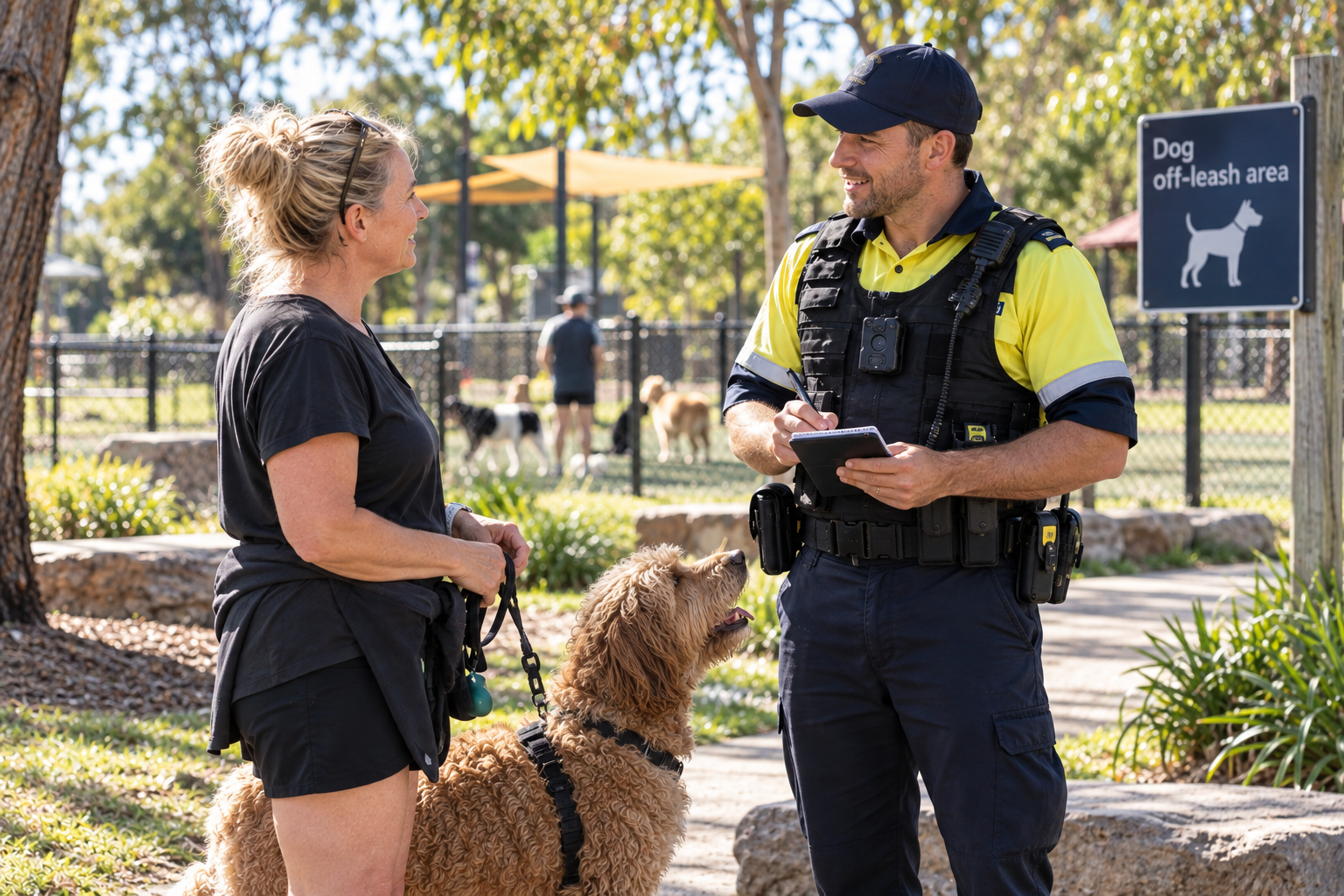
Think your well-behaved dog is safe from an off-leash fine because it’s under control? You might want to think again.
On the Sunshine Coast, 141 fines totalling $121,683 were issued in just over two months after new dog rules came into effect on July 3, 2026. At $863 a time, that’s a fairly compelling reason to understand exactly where dogs can — and can’t — be off lead.
Most owners know the basics: put the dog on lead where required, pick up after it and head to a designated off-leash area when it’s time for a run. But there’s one phrase in Brisbane’s dog rules that’s easy to misunderstand: “effective control”. Does that mean a perfectly obedient dog walking quietly beside you can be off lead? Does voice control count? And are the rules different once you enter a designated off-leash area?
So what does “effective control” actually mean?
Brisbane City Council says that when walking a dog in public, it must be securely on a lead unless it is in a designated and signed dog off-leash area. The person handling the dog must also be physically able to control it.
It would be easy to read “effective control” as meaning an exceptionally obedient dog doesn’t necessarily need a lead. If your dog walks beautifully beside you and comes immediately when called, surely it’s under control? Yes — but that doesn’t give it a free pass to be off lead.
Queensland legislation makes an important distinction. In a designated off-leash area, effective control can mean supervising the dog and being able to control it by voice command. In other public places, effective control means being physically able to control the dog and restraining it as required — normally by holding it on a lead.
In other words, where a lead is required, the lead is part of effective control. Even a beautifully trained dog walking quietly at heel can still land its owner in trouble if it’s off lead in the wrong place.
Watch those council boundaries
There’s another wrinkle if you venture outside Brisbane. Council rules aren’t necessarily the same from one local government area to the next.
In neighbouring Logan, for example, a dog in a public place must be held on a leash no longer than two metres to meet Logan’s effective-control requirements. Brisbane doesn’t specify the same two-metre maximum for an ordinary dog.
If you’re travelling in another council area, it pays to check the local rules rather than assume they’re the same as Brisbane’s. Until you know, a normal lead is a safer choice than a long line or extendable lead.
And that can be expensive
Brisbane City Council currently lists the fine for failing to effectively control a dog in a public place at $863. The dog doesn’t have to be causing trouble for the rules to apply. A friendly Labrador doesn’t get an exemption, and neither does a competition obedience dog with a brilliant recall.
If a lead is required, use one.
What about off-leash areas?
Taking the lead off doesn’t mean taking responsibility off with it. In a designated off-leash area, owners still need to supervise their dogs and be able to control them. A dog park isn’t simply a fenced space where dogs are released and left to sort things out among themselves.
For many dogs, off-leash areas can be great fun. But they don’t suit every dog. An anxious, reactive or easily overwhelmed dog may find a busy fenced park anything but enjoyable, and some dogs simply prefer a quieter outing.
That may also help explain why dogs sometimes turn up in off-leash parks even though the environment doesn’t particularly suit them. With fewer places where dogs can legally run free, owners may feel their options are limited.
It pays to be selective about when — and whether — to use a dog park. Quieter times may suit some dogs better. Watch the dogs already inside before entering, keep an eye on interactions and be prepared to leave if things aren’t looking comfortable.
And there’s no rule saying every dog has to enjoy a dog park. A long-line sniffing walk where permitted, a training session, a carefully chosen outing with a compatible dog friend or simply exploring somewhere new may be a much better fit.
Or, of course, there’s always jogging.
So how do you avoid a fine?
Fortunately, most of it comes down to fairly simple habits. Check the signs rather than assuming a familiar park is off lead, and keep your dog on lead unless you’re certain you’re in a designated off-leash area.
When your dog is legally off lead, keep watching what it’s doing and make sure you can call it away when necessary. If you cross into another council area, check the local requirements because the details can change surprisingly quickly.
A lead, a glance at the signs and a little local knowledge can save an unexpectedly expensive walk.