
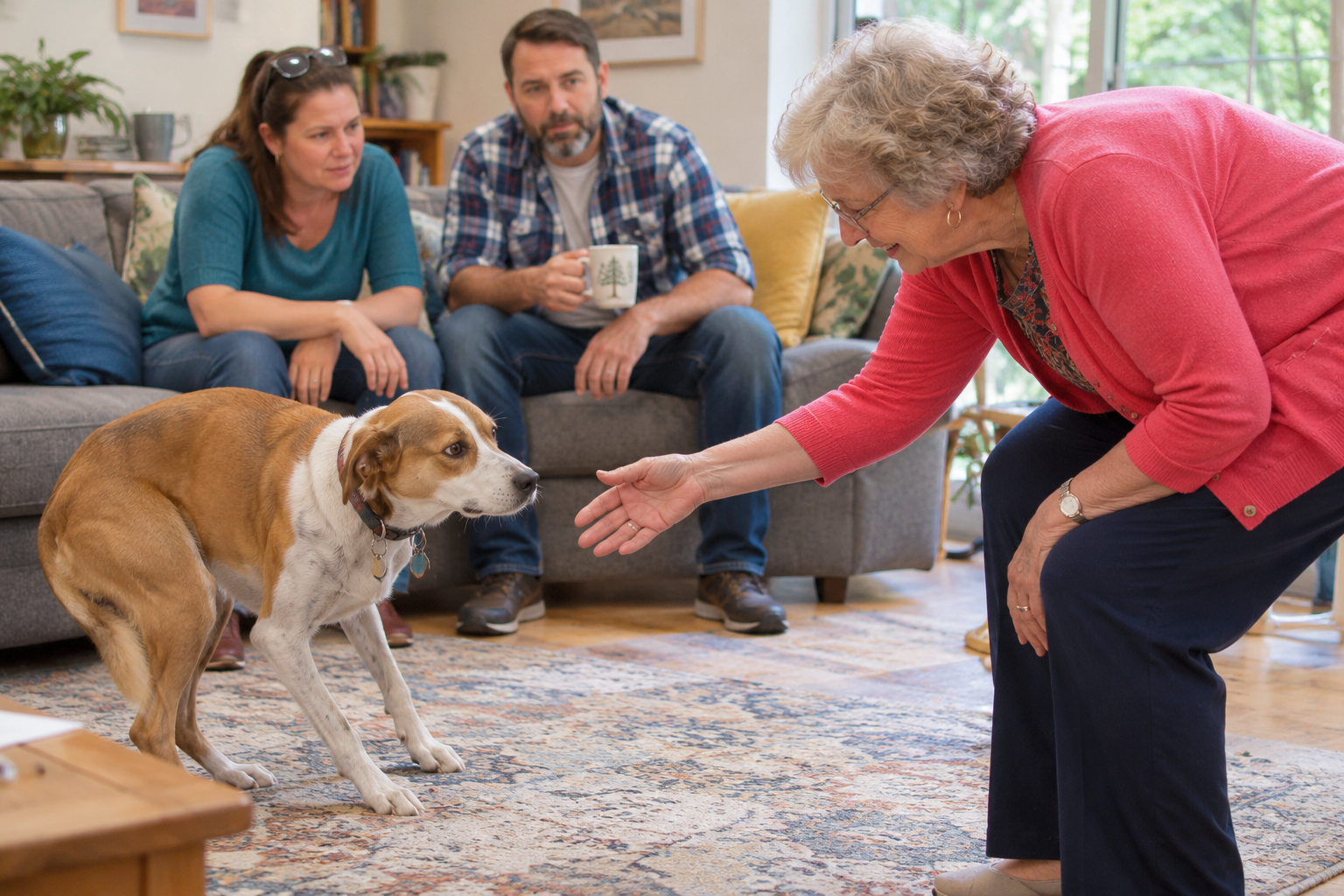
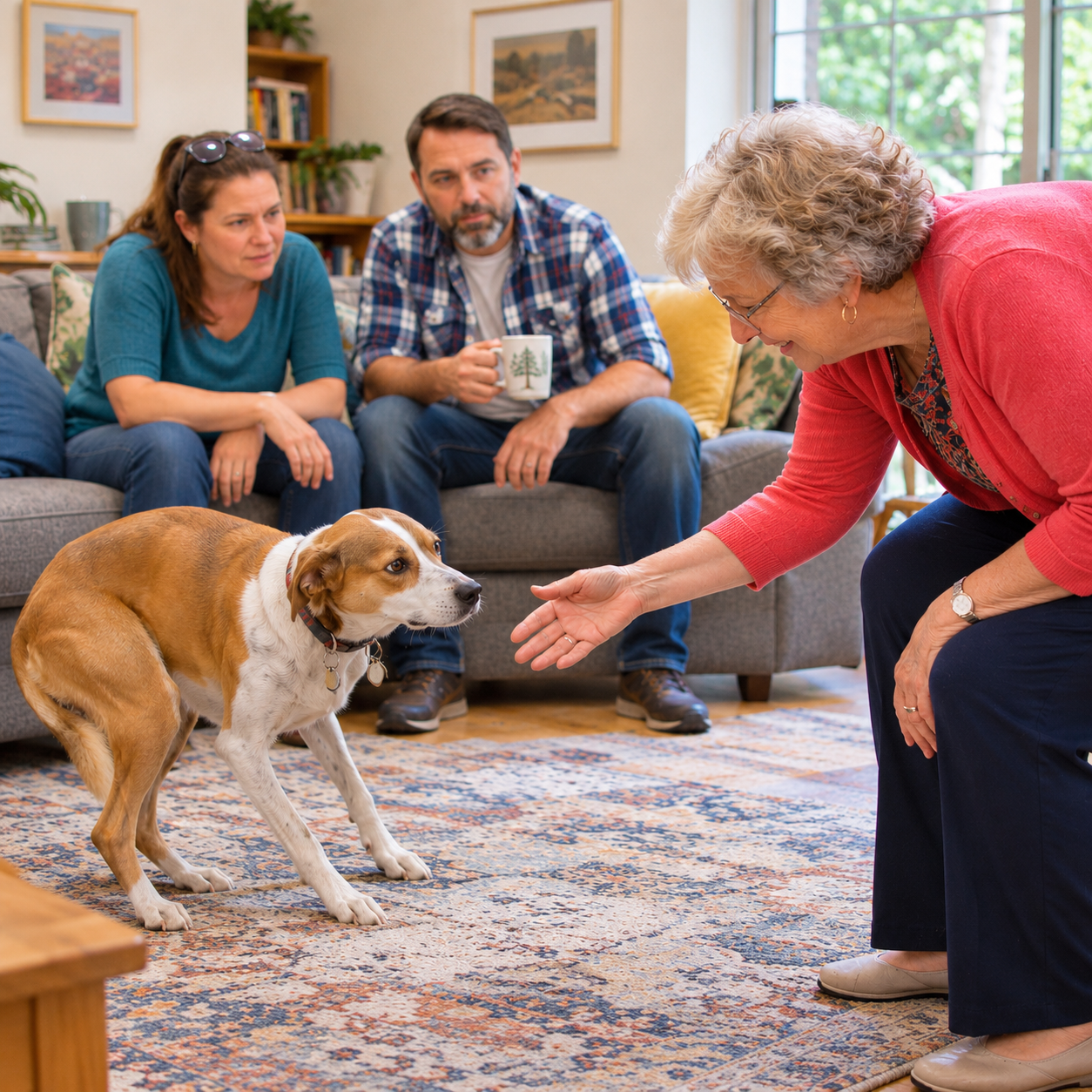
Your dog loves you, adores the kids and happily greets most visitors. But when your mother-in-law arrives, his tail disappears between his legs and he heads for the nearest exit.
Your mother-in-law, unfortunately, is determined to make friends. She follows him, bends down and tries to pat him. He retreats. She persists. Eventually, he growls.
At this point, you might be thinking your dog has excellent taste. Yes, we know. It’s the obvious mother-in-law joke, but we thought we’d get in before you did.
Now, before family relations deteriorate any further, let’s look at what’s really going on.
First, which dogs are we talking about?
This is the friendly dog who likes 90% of people but takes exception to the occasional individual. Not the territorial dog who believes every visitor has come to burgle the house, or one who regularly threatens strangers. Those dogs need a different approach.
Why this person?
Dogs notice things we barely register: size, silhouette, movements, voice, scent and body language. Leaning over, staring or approaching directly may unsettle a sensitive dog. Even a hat, umbrella, bulky bag or walking stick can change someone’s appearance enough to cause concern.
Research has found that some dogs are more uneasy around unfamiliar men. Size, voice and movement are possible explanations, not proven causes. Familiarity may matter too. A puppy raised mainly around women, then living in a household with little male contact, may have fewer positive experiences with men.
And there’s scent. Studies show dogs can detect human stress-related odours, which can influence their responses. That doesn’t mean they can smell a bad person or that perfume explains your mother-in-law problem.
Don’t assume he was mistreated
How often do we hear, particularly about rescue dogs, “He must have been beaten by a man”? Past experiences matter, but so do temperament, genetics, socialisation and everyday learning.
Take one normally friendly dog who disliked a man whose home he regularly visited. He had to stay in the yard while everyone else enjoyed the house. Before long, he’d look at the man and turn away with what could only be described as utter disgust. Had he connected the man with his backyard banishment? We can’t know for certain, but the association is entirely plausible.
The growl wasn’t the first warning
Back to your mother-in-law. Every time your dog retreats, she follows. Every time he avoids her hand, she tries harder. She means well, but she’s making things worse. A tucked tail, lowered body, lip licking or walking off can signal discomfort. The growl often comes after those quieter messages have been ignored.
Your dog has been trying to say no politely. The growl is what happens when nobody takes the hint.
Don’t punish it. Stopping a warning doesn’t remove the underlying worry and may increase bite risk.
Making friends without trying too hard
Ask your mother-in-law to stop approaching, staring at or reaching for the dog. Give him room to retreat. At CLEAR Dog Training, one favourite exercise is the Freebie game. At home, occasionally call “Freebie!” in a happy voice and toss a tasty treat for your dog to collect. With practice, it becomes a joyful cue and a foundation for emergency recall.
Once he knows the game, play a couple of Freebies yourself while your mother-in-law stays at a comfortable distance. If he’s relaxed, she can toss a few treats away from herself, without moving towards him. Keep the game gentle if he’s worried; don’t use food to lure him closer.
If he approaches to sniff, that’s not an invitation to pat him. Reaching towards a dog who’s still uncomfortable can prompt a defensive snap. Let him choose whether to stay or move away.
Another option is a walk together, with your mother-in-law a couple of metres away, or further if needed. He can sniff and explore without anyone invading his space.
Start early – prevention is better than cure
Sometimes these seemingly inexplicable dislikes may be linked to a lack of positive experiences with different types of people. That’s one reason early socialisation matters. It won’t guarantee a dog who loves everybody, but it can help puppies become more comfortable with the wider world.
During the early socialisation period, particularly before about 16 weeks, help your puppy have positive experiences around people of different ages, sizes and appearances. If you’re a woman living alone, make an extra effort to include men. Ask your vet about safe outings before vaccinations are complete rather than keeping your puppy isolated at home.
Find a quiet spot where your puppy can sit comfortably on your lap and watch people passing. Take some tasty treats. If a friendly passer-by admires him, explain you’re socialising your puppy and ask whether they’d mind offering a treat. For a hesitant puppy, have them toss it gently instead, without approaching.
Don’t feel comfortable asking a man walking alone? Look for a friendly couple. Your puppy gets to meet a man and a woman – two for the price of one! And he’s less likely to think you’re trying to pick him up.
Remember, socialisation isn’t about having everyone pat your puppy. Calmly watching different people come and go, without needing to interact, is valuable learning too.
He doesn’t have to love everybody
If your usually friendly dog simply avoids one person, respecting his space and building pleasant associations may help. But if he has snapped, lunged threateningly or bitten, use extra safety measures and seek qualified help. Even a dog with no bite history can react defensively if cornered.
Your dog doesn’t have to become best friends with your mother-in-law. If he can relax on his bed while she enjoys a cup of tea, that’s a success. And if he still prefers to keep his distance? Perhaps he’s simply better than the rest of us at setting boundaries.
Can we help?
CLEAR Dog Training offers one-on-one, in-home training throughout Wynnum–Manly and surrounding suburbs. Contact us for a friendly chat about you and your dog and how we can help.