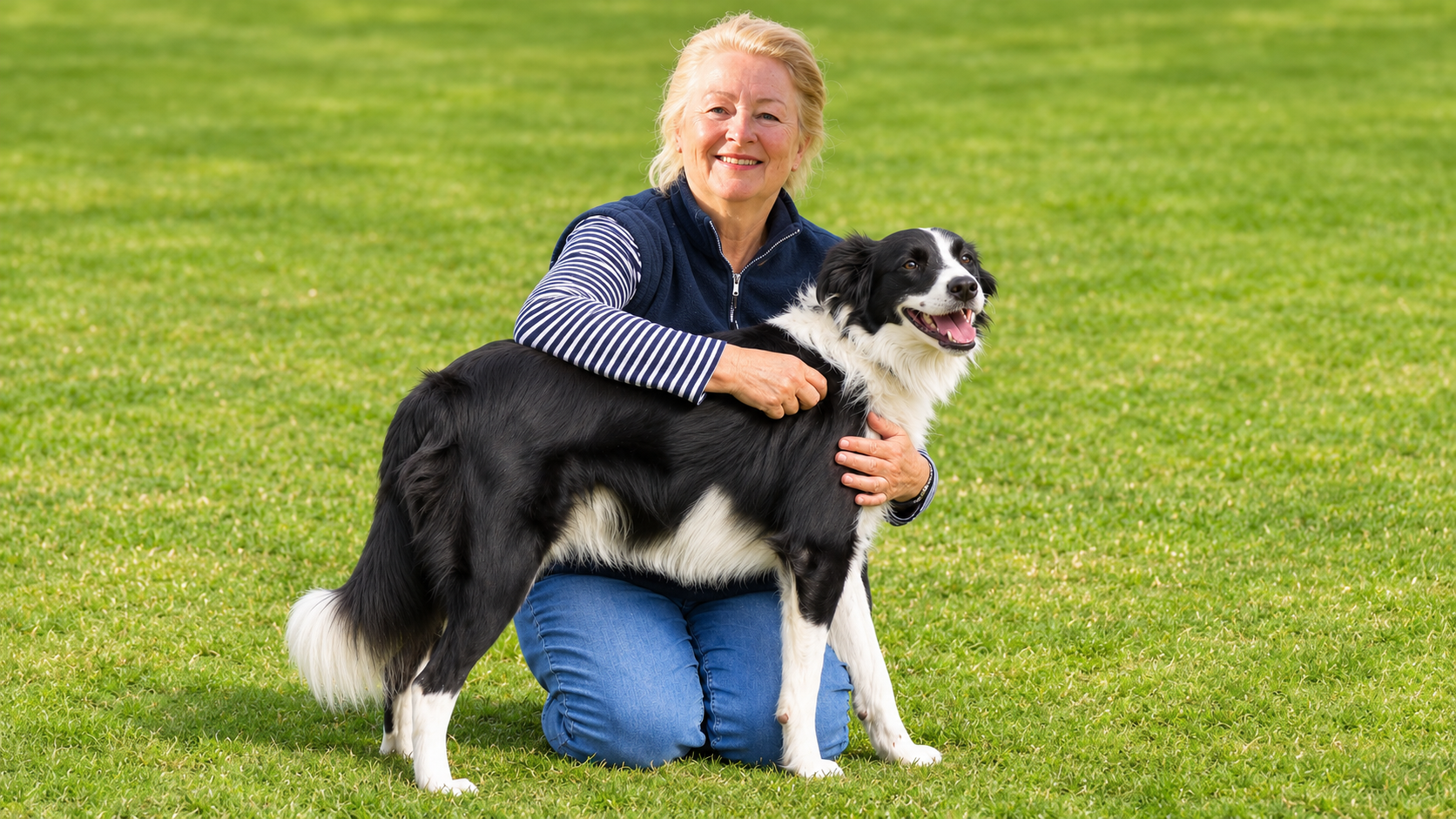
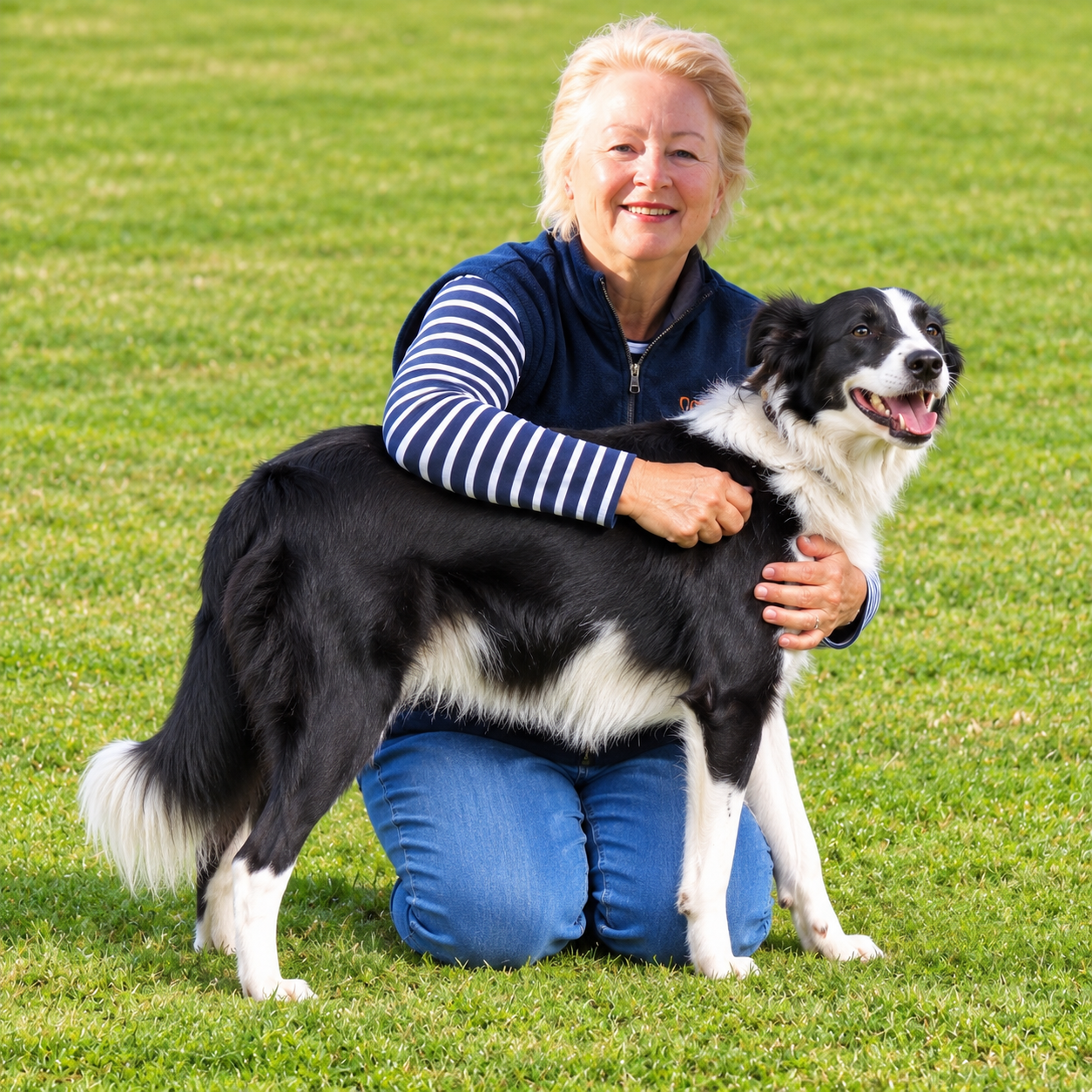
Dog training has changed enormously over the past 40 years, and CLEAR Dog Training owner Caroline Strainig has witnessed some of its most significant changes during her own training career. Her approach today is a long way from the check chains, lead corrections and occasional words of praise that were commonplace when she started training at a local dog club.
The journey from those early lessons to the modern, positive, practical methods used at CLEAR began with a chance encounter that opened the door to a whole new world of dog training.
Caroline’s story: A first taste of dog training
For Caroline, it all started about 30 years ago. She had retired from equestrian sport and was missing the excitement of training her horses and the thrill of competition. Living in Wyong on the NSW Central Coast, she walked past a local park one day and spotted a woman running a dog training session. She stopped to watch, liked what she saw and returned the following week with Blade, her little Koolie cross.
It took all of one lesson for the instructor to tell her, “You’ve got to do dog sports.” She’d spotted an addict in the making. She was right. Blade went on to win an obedience competition, and the pair dabbled in agility and flyball. He was a capable, workmanlike little dog who did what Caroline asked without getting terribly excited about it.
Caroline loved going to training, although the methods were rather different from those she uses today. Check chains, lead corrections and a word of praise were standard practice. Some trainers were beginning to use food rewards, but they were still in the minority, as Caroline remembers it. A treat might be given here and there, often without the timing and consistency needed to help the dog understand exactly what earned it. Some dogs performed their exercises with almost military precision. They did the work well, although they didn’t always look as if they were having much fun.
Then she saw the Wonderdogs
Everything began to change when Caroline watched trainer Kelly Gill performing with the Wonderdogs, her wonderful chocolate-and-white Border Collies. They were skilful, enthusiastic and looked as though they’d happily do it all again.
Caroline wanted to know how Kelly brought that out in them, so she went along to Cessnock Dog Club for a couple of lessons with Kelly, another trainer called Anne and others who were exploring different approaches. Kelly recognised Caroline’s enthusiasm for learning more about dogs and how to train them. When Canadian trainer Susan Garrett was coming to Castle Hill to give a seminar, Kelly urged her to go. Caroline took her advice.
The day the light went on at Castle Hill
It was a total eye-opener. Garrett seemed able to get inside a dog’s head. She could spot the beginnings of the movement she wanted and mark it the instant it happened. She knew what that particular dog would find rewarding and where to deliver the reward so the dog was in a good position to try again.
She broke exercises into small, achievable steps, helping dogs discover for themselves what earned the reward, and made a game of the whole thing. At Castle Hill, Caroline began to understand how a trainer could bring out the enthusiasm she’d seen in Kelly’s dogs. Garrett has been one of her favourite trainers ever since.
Caroline describes Garrett’s approach as kind but firm. Garrett paid as much attention to the rewards a dog found for itself as she did to the ones she handed out. Caroline remembers an example from Garrett’s book Ruff Love involving a dog having a wonderful time in a pond when it wasn’t supposed to be there. As Caroline recalls it, Garrett waded in, took hold of the dog and brought it out.
That image stayed with Caroline. Garrett could make getting it right so rewarding that a dog wanted another go. But when the dog found its own fun doing something she didn’t want, she was prepared to step in and end the game. It was a lesson in being proactive, recognising what motivates a dog and remembering that not all rewards come from the trainer.
Trying it with her own dogs and fosters
Back on the Central Coast, Caroline experimented with her own adaptation of an idea from Ruff Love, using it with a couple of her dogs and some of the rescue dogs she fostered.
Her own dogs were family dogs first, so she adapted the approach rather than following Garrett’s original programme in full. Before a training session, she’d sometimes give a dog a couple of quiet hours in a comfortable pen of its own, away from the bustle of the other dogs. It wasn’t punishment or an attempt to deprive the dog of companionship, simply an opportunity to rest without distractions. When she came back, the dog was rested, fresh and keen to have some fun with her.
Caroline still sees the value of a proper break at a training club or competition. A dog that’s comfortable in a crate can rest, come out for a short, enjoyable session and then have another chance to switch off. Spend the whole evening with your dog hanging off your arm like a handbag while you chat and wait your turn, and by the time you’re ready to train, you may have become the most boring thing at the other end of the lead.
What Oliver brought to CLEAR
Years later, while studying dog training, Caroline rang CLEAR founder Oliver Beverly to ask if she could watch him work. By then, Oliver had established a reputation as an outstanding trainer, with people travelling considerable distances to seek his help.
Caroline learnt an enormous amount from watching him. She admired his ability to understand what made an individual dog tick, work out why a problem was happening and come up with practical solutions that owners could use. His calm, positive approach, emphasis on consistency and ability to communicate clearly with both dogs and people struck a chord with her.
When Caroline eventually took over CLEAR, she embraced Oliver’s philosophy and built on it, incorporating more reward-based games, play and fun into her training. The underlying principles remained the same: understand the dog, be kind but firm, and give owners practical tools that work in everyday life.
Caroline has continued to learn from trainers and behaviourists she admires. Patricia McConnell’s work on understanding canine behaviour, Susan Garrett’s reward-based training and the relationship-building games developed by Absolute Dogs have all influenced her thinking. She draws on ideas from these sources, adapting them to suit individual dogs and their owners rather than following any one method unquestioningly.
Shouldn’t my dog do it because it loves me?
Caroline still hears this from owners. But would you keep turning up to work if the pay stopped, even if you liked the people you worked with?
Your dog can adore you and still find the smell on the other side of the park more compelling than coming when called. A well-timed reward gives it a reason to choose you again. Over time, all those little moments help build a dog that looks forward to whatever you might have in mind.
And rewards don’t have to mean expensive treats or endless handfuls of food. A little of the dog’s daily food is handy because you can deliver it at exactly the right moment. A quick game of tug might mean more to some dogs. For a dog that loves exploring, hearing “Go sniff” after a stretch of loose-lead walking can be a reward in itself.
Even your voice can take on a gloss of its own. Pair a warm “Good dog” with something your dog loves often enough, and those words can begin to carry some of that pleasure themselves. The trick is discovering what your dog genuinely values, rather than assuming that what you consider rewarding will be equally appealing to the dog.
Becoming a team
For Caroline, being a good team leader means thinking ahead. You use food, play and the things your dog loves doing to build the behaviours you want. You calmly manage and prevent the ones you don’t want, giving the dog fewer opportunities to practise them. Then you watch for opportunities to reward the dog for making good choices.
It doesn’t mean letting your dog do whatever it likes. Boundaries are important, but they can be taught without intimidation or unnecessary corrections. Being kind and being firm aren’t mutually exclusive.
One of Caroline’s favourite moments during a training session is watching an owner’s face when the penny drops. They’ve spent years telling their dog what not to do, and suddenly discover how much more effective it can be to show the dog what they do want and reward it for getting things right.
The result is a dog that’s not just doing what it’s told, but enjoying working with its owner.