
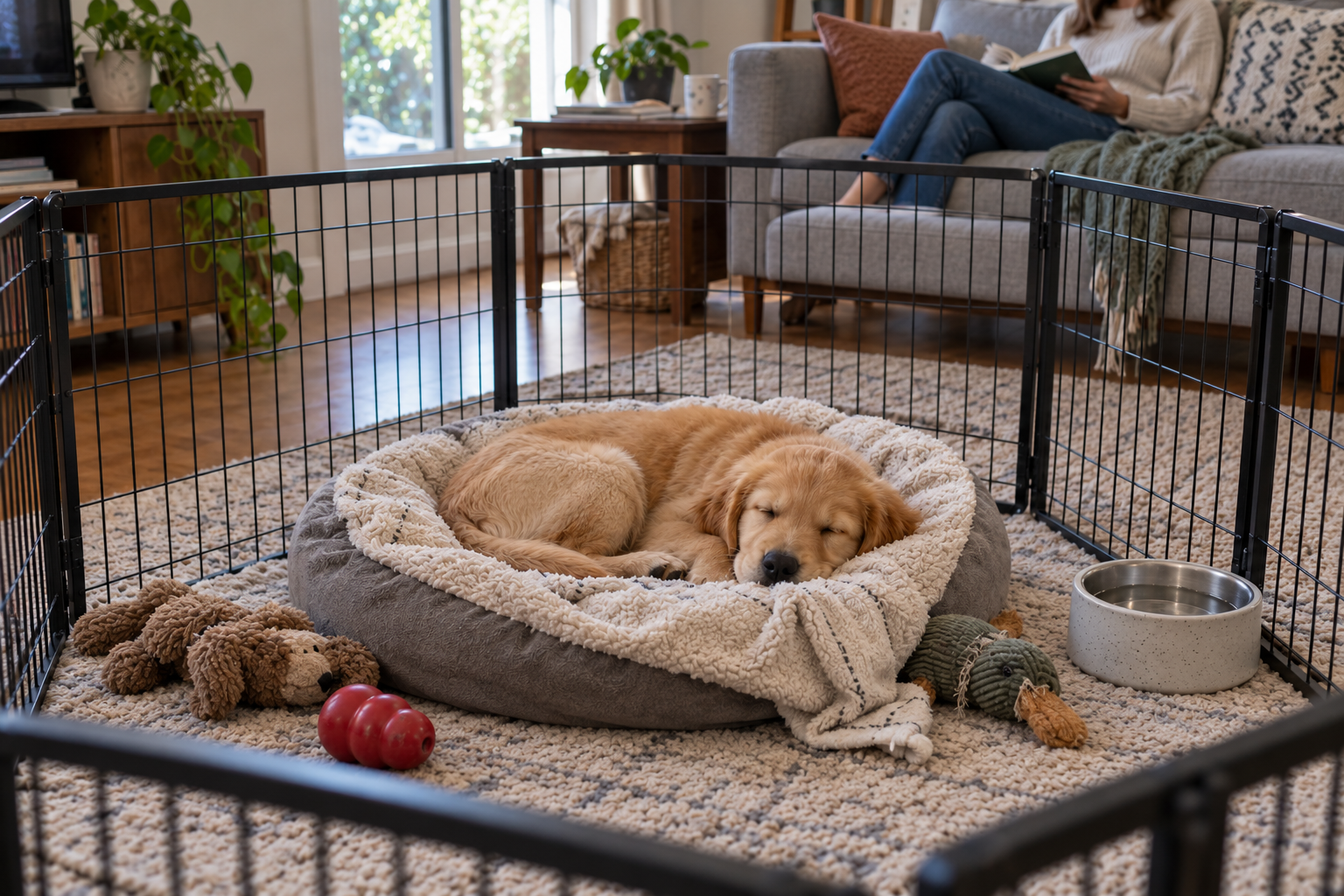
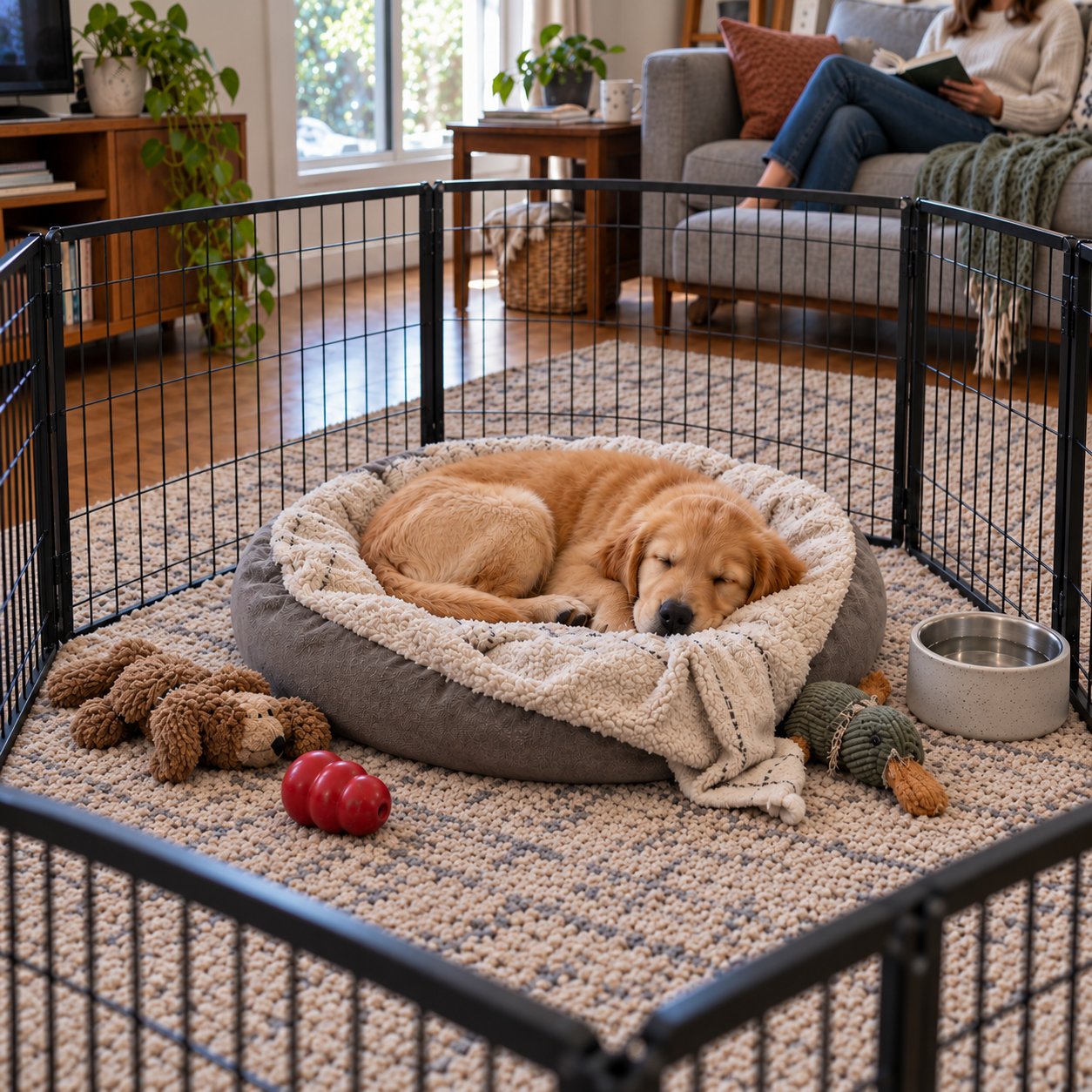
Your puppy sleeps happily in a crate all night — so why do they scream the house down when you try the same thing during the day?
It’s something CLEAR Dog Training clients ask about regularly. Whether it’s a crate, pen or space behind a puppy gate, some puppies object loudly during the day — even with someone sitting nearby.
At night, the household goes quiet and there’s very little to miss. During the day, people are moving around, doors are opening, meals are being prepared and interesting things are happening. Your puppy may be tired, but still very keen to know what everyone else is doing.
Being able to see you without getting to you can sometimes make matters worse. If your puppy already settles comfortably overnight, though, that does give you a useful head start.
Crates, pens and puppy-proofed areas can make everyday life considerably easier, particularly when you can’t give a puppy your full attention. Crate and pen training are optional parts of the CLEAR Dog Training program, but learning to spend time apart from you is still a very useful skill.
Start building independence early
Once your puppy has got over the main hurdle of moving into a new home and is beginning to feel safe and secure, start introducing little periods apart from you.
That doesn’t necessarily mean putting the puppy in a crate or pen. It may simply mean using a puppy gate while you go into another room, working somewhere the puppy can’t follow, or leaving them in a safe puppy-proofed area while you get on with something elsewhere in the house.
It’s very easy in the first few days to let a puppy follow you everywhere. They’re lovely company, you want to keep an eye on them, and having them nearby makes supervision easier.
But if your puppy spends every waking moment following you from the kitchen to the bathroom, bedroom and back again, suddenly being shut behind a gate can come as quite a shock.
You don’t have to make a big event of these separations. Leave the puppy somewhere comfortable with a chew or toy and go about your business. At first, you might only disappear for a minute or two.
Puppy gates are particularly useful because they allow some separation without necessarily isolating the puppy completely. Sometimes they can still see you. Sometimes you might disappear into another room for a while.
There’s still plenty of room for cuddles, play and companionship. The aim is simply to avoid making following you everywhere the only pattern your puppy knows.
Pick your moment
Timing can make a considerable difference when you do want your puppy to settle in a crate, pen or puppy area.
A puppy who has been to the toilet, had a bit of activity and is ready for a nap is more likely to settle than one who has just woken up and wants to play.
You may already notice a pattern: a burst of morning activity followed by a sleepy spell, or a quiet period after lunch. Those are useful times to practise.
Some gentle play or exploration beforehand may help, but there’s no need to try to exhaust the puppy. An overtired puppy can sometimes be just as difficult to settle as one with energy to burn.
A comfortable bed, water and a suitable position matter too. Some puppies rest happily near the family; others find it easier a little further from the bustle. You may need to experiment with where the area is placed.
Make the area somewhere your puppy likes being
If the crate, pen or puppy area only comes into use when you’re busy and the puppy is shut away, it may not have much appeal.
Favourite chews, stuffed Kongs, lick mats, snuffle mats and meals can all be enjoyed there. If suitable bones are already part of your puppy’s routine, this may be somewhere they have them under supervision too.
Choose items appropriate for your puppy and watch how they use anything new before deciding what can safely be left with them.
Sometimes leave the entrance open so your puppy can wander in, enjoy something and come out again.
Susan Garrett’s Crate Games can also be very useful. With the door open, toss a treat inside and make “In your crate!” or “In your pen!” a cheerful little game. Once the puppy understands, you can build up to a playful race there.
You can also practise opening the door without it automatically meaning the puppy charges out. Open it a little and reward them for staying inside. If they move towards the opening, gently close it again before they reach it, keeping noses and paws clear. A separate release word tells them when they can come out.
Keep those sessions short.
Build up the quiet time gradually
Enjoying a chew in the area is one thing. Resting there while you get on with something is another.
Early practice may only last seconds.
Choose a naturally quiet moment and briefly close the gate or door while your puppy is comfortable. Open it again before things start to unravel.
Next time, you might sit nearby for a little longer, stand up and sit down again, or take a few steps away. Going out of sight can come later.
It helps not to make everything harder at once. Staying there longer and having you further away are two different challenges.
If your puppy objects almost immediately, shorten the time, stay closer or change the setup. A few easy repetitions are usually more useful than repeatedly trying for half an hour and ending up with a screaming puppy.
Reward calmness quietly
Sometimes a puppy finally goes quiet, the owner walks over to praise them enthusiastically, and the crying starts all over again.
From the puppy’s point of view, your approach may mean something exciting is about to happen — play, cuddles, freedom, or all three.
A quieter reward can work better. You might simply place a treat beside the puppy and move away again without making a fuss.
It’s also useful to notice calm behaviour before the crying starts. A puppy lying quietly on its bed, chewing something or simply watching you without getting up is already doing what you want.
If they’re asleep, leave them asleep.
Some CLEAR clients have had good results with remote treat dispensers such as the Furbo. These let you watch through a camera and reward calm behaviour without walking over and potentially stirring the puppy up again.
The useful thing to watch is what happens afterwards. A puppy who eats the treat and settles back down may benefit. One who becomes excited, barks at the machine or sits waiting for another delivery may not.
What if the crying starts?
Even with good preparation, there will be times when your puppy complains.
Check the obvious things first. Do they need the toilet? Are they uncomfortable? Have they had enough interaction and activity? Is the exercise simply too difficult at this stage?
A camera can be extremely useful once you start moving out of sight. You can see whether the puppy has a brief grumble and then returns to a chew or curls up, or whether the behaviour is escalating.
A recording can also be revealing. The first 15–20 minutes of an absence may show you a very different picture from the one you imagined.
That doesn’t mean leaving a distressed puppy crying for 20 minutes to see what happens. If you’re watching live and the puppy is becoming increasingly upset, go back and help them.
If there is a natural pause during a brief complaint, that can be a sensible time to calmly open the gate. There’s no need to wait indefinitely for silence while the puppy becomes more and more distressed.
Persistent pacing, drooling, panting when they’re not hot or frantic escape attempts deserve closer attention. If your puppy repeatedly becomes very distressed when left, speak with your vet and a suitably qualified behaviour professional.
The CLEAR Dog Training article on barking when you go out looks more closely at “Velcro dog” behaviour and separation anxiety.
Making it work at home
Nobody can supervise a puppy every second, which is why safe puppy areas can be so useful.
Depending on your home and your puppy, that may be a crate, pen, puppy-proofed room, a gate across part of the house or simply a secure area where they can settle while you’re elsewhere.
If your puppy already sleeps happily at night, daytime settling may just need to be taught separately. During the day there is more going on, more temptation to follow you, and more opportunity for a young puppy to feel that it is missing out.
Start introducing those small periods apart once your puppy has settled into the home, rather than waiting until the day you suddenly need them to cope alone.