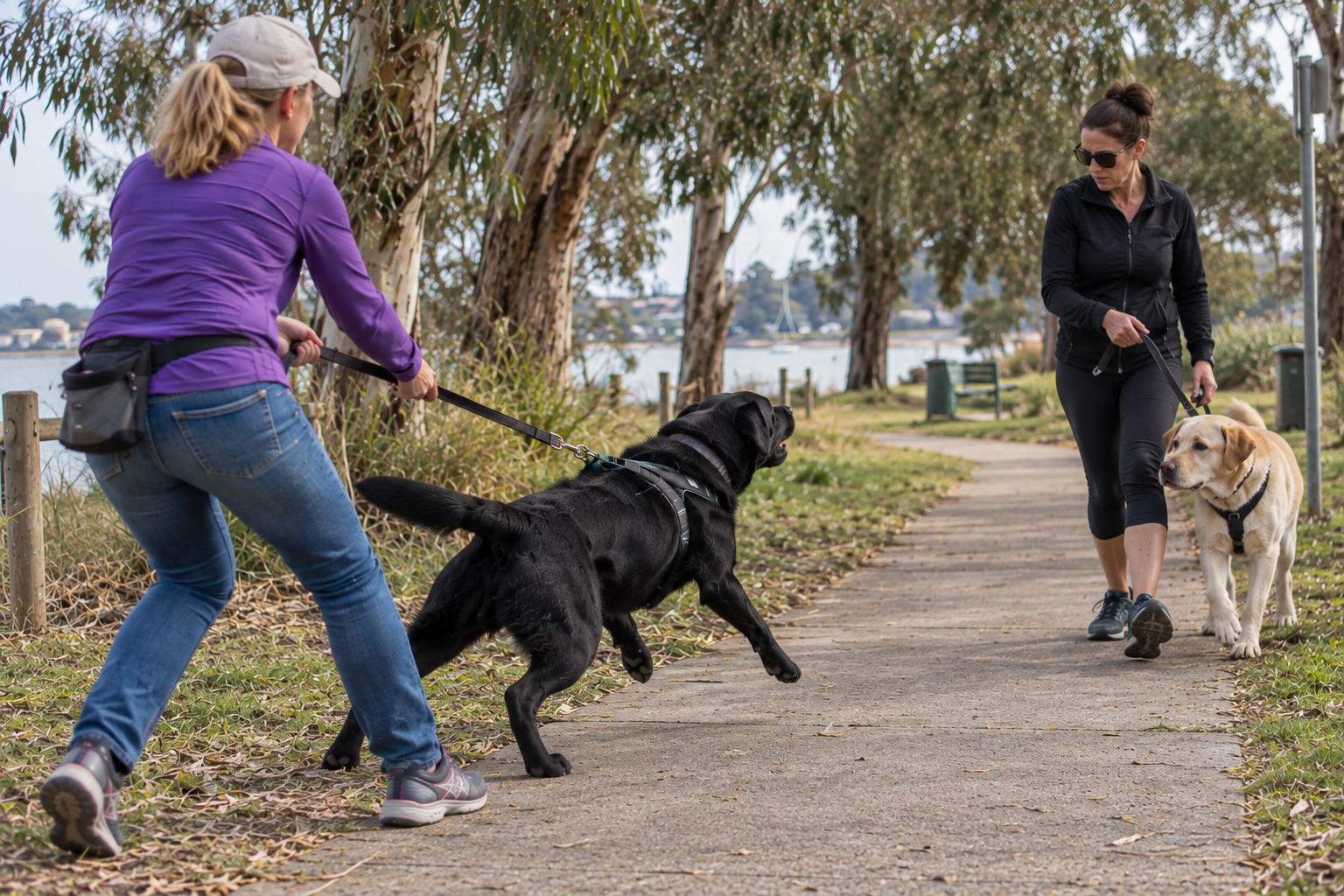
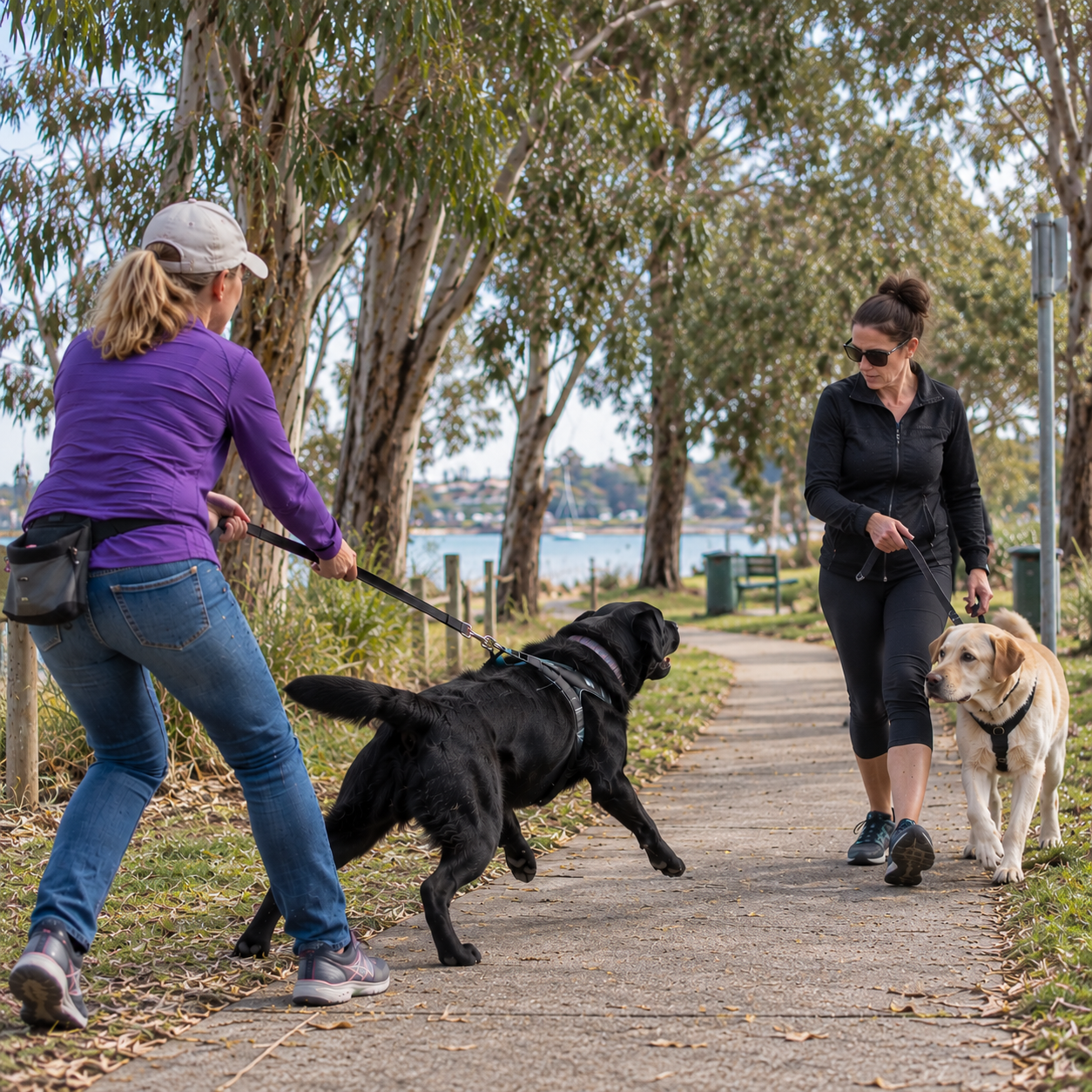
One surprisingly common problem is the otherwise well-behaved dog who walks nicely enough — until another dog comes along. Then suddenly they’re staring, pulling and lunging at the end of the lead.
Sometimes this is part of a wider pattern of reactivity or aggression. But not always. A dog that is generally sociable and easy to live with can still develop a very specific habit of lunging at other dogs on lead.
Reactivity doesn’t automatically mean aggression
Dogs lunge for different reasons. Some are worried. Some are frustrated because the lead prevents them reaching another dog. Others are wildly excited or conflicted. Occasionally, the intention may be less friendly.
The rest of the dog can tell you quite a lot. A dog straining forward with loose, bouncy body language and an excited whine may simply be desperate to get closer. A dog that becomes very still, hard and threatening before launching may be telling you something quite different. Look at the whole picture. A wagging tail, for example, doesn’t automatically mean a happy or friendly dog.
A dog can also be perfectly sociable off lead yet lunge on one. Off lead, dogs have choices. They can slow down, move away, approach in an arc or decide not to interact. A lead removes some of those choices.
If lunging is part of a broader pattern of reactive or aggressive behaviour, it needs to be looked at in that wider context. The dog may need a more comprehensive management, training and counter-conditioning plan.
An ounce of prevention
An ounce of prevention really is worth a pound of cure with lunging. If it starts, tackle it early — and better still, start before it happens.
From puppyhood, teach your dog that seeing another dog doesn’t automatically mean going over to say hello. Reward them for walking calmly past other dogs as well as for appropriate greetings. Use simple cues such as “Let’s go” or “This way” to keep moving, change direction or create more space.
A hyper-social puppy allowed to greet every dog can easily learn see dog, meet dog. When that puppy becomes an adolescent and access is suddenly denied, frustration can turn into staring, pulling and lunging. The aim is for your dog to become just as happy walking past another dog as saying hello to one.
The lunge isn’t the beginning
The lunge gets everyone’s attention, but the useful information often appears several seconds earlier. The dog may stop sniffing, close their mouth, stiffen, lean forward or begin to stare. Spot those changes early and you have far more options than once the dog is at the end of the lead.
Many dogs that lunge have what we think of as a bubble distance — a point beyond which they can see another dog and still think and respond. Get too close and things can unravel quickly. At CLEAR, we call the extreme version “space cadet mode” — the lights are on, but nobody’s home.
The three Ds of training — distance, duration and distraction — are useful to remember. Make one harder and it can help to make another easier. Move closer but keep the exposure brief. Want to work for longer? Add distance. Somewhere busy and distracting? Give yourself more room. And remember that the bubble can change from one day to the next.
Management is paramount
Don’t keep walking your dog towards other dogs and hoping things will get better. If lunging has started, try to stop the dog rehearsing it while you work on the behaviour.
That may mean avoiding a busy two-metre-wide boardwalk where dogs are coming towards you and there’s nowhere to go. Choose somewhere with room to cross over, circle away, change direction or put a parked car between you and another dog.
A suburban walk where dogs repeatedly rush fences and bark as you pass can also leave an already excitable dog wound up. Make sure some walks are in quieter places where your dog can sniff, potter about and simply enjoy being out.
Lunging can become patterned to particular places, situations and even handlers. CLEAR is currently working with a dog that regularly lunges and barks at other dogs when walked by its owner, yet behaves relatively well with a different handler along the waterfront. Under enough pressure, particularly where the behaviour has been heavily rehearsed, the dog may still revert. What starts for one reason can become a well-practised habit.
Safety comes first. Use equipment you trust, think about your footing and don’t put yourself, your dog or somebody else’s dog at risk for the sake of a training exercise.
Put some tools in the toolbox
Good basic obedience gives you options when another dog suddenly appears. Three particularly useful walk cues are “Let’s go” to move off together, “This way” for a change of direction, and “Wait” for a brief stop.
“This way” is a favourite. Train it as a sharp 180-degree turn and you have an escape route in your pocket. Don’t fancy meeting Mrs McGregor and her two poodles on a narrow path? “This way”, about turn and head back. Or circle away and come around again with enough distance to pass comfortably.
Equipment can sometimes help too. With some dogs, we’ve found a Halti head collar useful for additional control, always used with a double-ended lead so unnecessary pressure isn’t put on the dog’s nose. It isn’t something we’d choose for a dog lunging through fear or anxiety, where adding discomfort could make an already difficult situation worse.
And don’t make the only training on your walk happen when another dog appears. Take treats and make the walk interactive. Sometimes simply slop along together on a loose lead; at other times play Freebie, practise a few walk cues or throw in another little game.
Find what works for your dog
There are different ways of working with lunging, and different dogs may need different approaches. These are simply some of the things we’ve found useful.
One is counter-conditioning at a distance where the dog can still cope. Let the dog see another dog and, if they can look calmly without tipping into fixation, mark it — we use a simple “Yes” — and reward. You’re beginning to change the pattern: another dog appears and good things happen.
The dog will often turn back towards you to collect the reward. With repetition, many dogs begin to see another dog and voluntarily check back with their handler. First reward the look; later, reward the look-away.
Another approach we’ve found useful with suitable dogs is sitting at a comfortable distance and watching dogs go past. A low wall can be ideal. The dog can sit between your legs while you securely but gently hold the lead and, where appropriate, the collar, marking and rewarding calm looks at passing dogs. If there’s a risk of being bitten, scratched, knocked over or having the dog twist free, choose another setup. No training exercise is worth getting hurt for.
Some dogs do better moving in broad circles. Others can sit and watch while you practically have a coffee. There isn’t one magic formula. Work with the dog in front of you and don’t be in a hurry to shrink that bubble.
Your dog doesn’t have to adore every dog they see. Sometimes the win is much less dramatic: There’s a dog. I’ve seen it. I’m okay. Let’s move on.
For a dog that once hit the end of the lead like a ballistic missile, that’s a very big win.